

Duct size has a direct impact on the performance of your range hood. This might seem like a minor technical detail, but it's worth your time and attention to get it right. This range hood duct size guide will answer your questions and provide clarity on this important topic.
Why Duct Size Matters
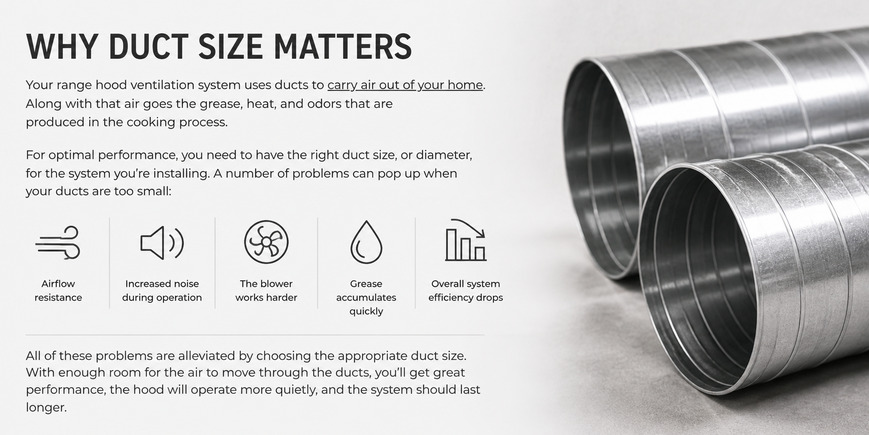
Your range hood ventilation system uses ducts to carry air out of your home. Along with that air goes the grease, heat, and odors that are produced in the cooking process.
For optimal performance, you need to have the right duct size, or diameter, for the system you’re installing. A number of problems can pop up when your ducts are too small:
-
Airflow resistance
-
Increased noise during operation
-
The blower works harder
-
Grease accumulates quickly
-
Overall system efficiency drops
All of these problems are alleviated by choosing the appropriate duct size. With enough room for the air to move through the ducts, you'll get great performance, the hood will operate more quietly, and the system should last longer.
6" Ducts Are a Starting Point
Consider 6'' ducts as a standard starting point for a builder-grade vent hood. This is usually the duct size used when a relatively lower-powered hood is installed in a kitchen.
When 6" Duct Size Can Work
When the range hood CFM, or cubic feet per minute, is under 400, a 6'' duct may be suitable. This can also be the correct duct size for an electric cooktop, or for a short duct length with a straight run to the outside. In a kitchen with light cooking demands and minimal bends, this minimum duct size can be effective.
Issues to Consider
Problems will arise if you use a 6'' duct to vent air with a more powerful blower. The small diameter of the duct will restrict airflow, leading to problems like those highlighted above. An undersized duct system will prevent your range hood installation from reaching its performance potential.
8" Ducts Hit a Performance Sweet Spot
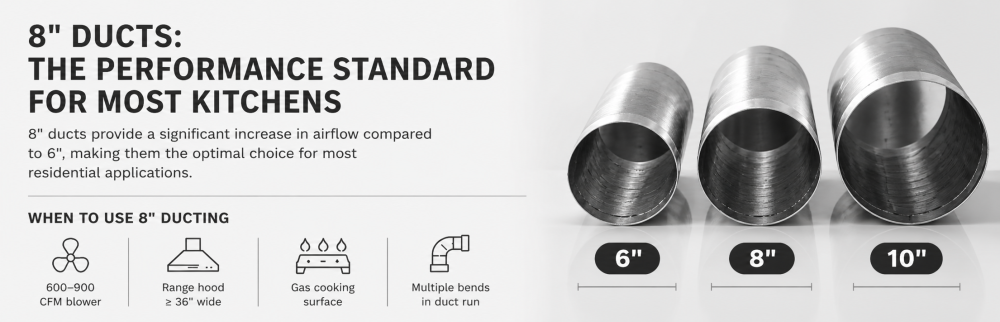
8'' ducts will be the perfect choice for many projects. Making the duct two inches larger might not sound like much, but adding two inches in diameter leads to a significant increase in overall area inside the duct. An 8'' duct can move significantly more cooking air through your kitchen range hood and out of the house.
Consider 8" Ducts in These Situations
When should you opt for 8'' diameter smooth metal ductwork? The following situations point to this option as your best bet:
-
You are using a blower in the 600 to 900 CFM rating range
-
Your range hood dimensions are at or above 36 inches wide
-
The kitchen features a gas cooking surface
-
Multiple bends are needed to route the duct to the outside
8'' ducts make it easier for your blower to effectively remove contaminants and keep the kitchen fresh. Of course, to ensure optimal performance, proper sealing needs to be completed so no air leaks pop up later.
10" Ducts Offer High-Performance Venting
For a kitchen that will see intense cooking activity, 10'' ducts offer excellent venting performance. A system fitted with 10'' ducts and a powerful blower motor can move a lot of air rapidly through the larger ductwork. The result is a kitchen that maintains great air quality even if your cooking habits include wok cooking, deep frying, and heavy searing.
Why 10" Ducts Are Common in High-End Kitchens
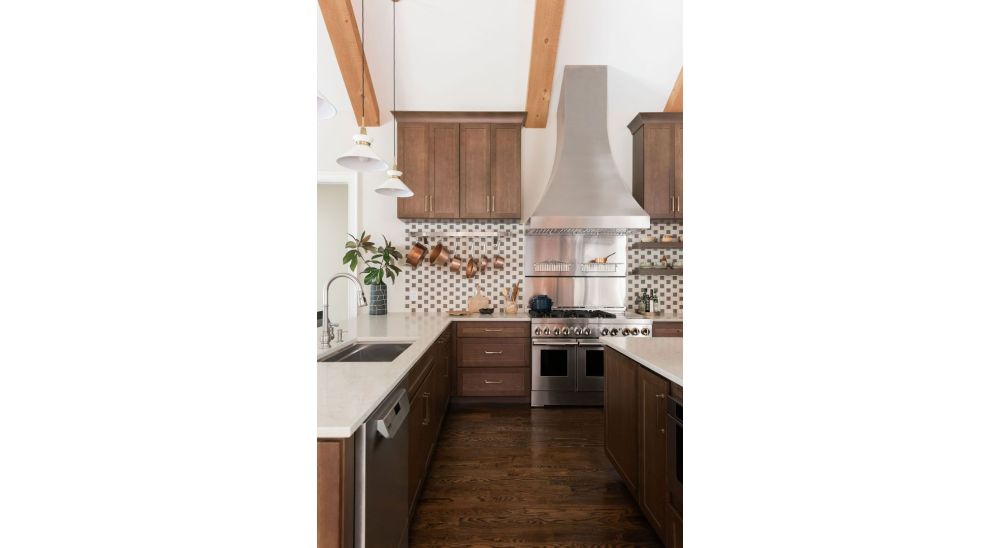
The types of professional-grade gas cooktops often found in high-end kitchens need excellent venting. Using larger diameters in the ductwork allows sufficient ventilation for such projects. Also, if you encounter complex installation scenarios that require multiple bends to reach the exterior, having 10'' ducts will allow air to flow freely even through those turns.
It also helps to have larger diameters as range hood duct length gets longer. High-end, luxury kitchens often have tall ceilings, meaning wall mounted hoods or island hoods may require an extended duct run. Medium-sized kitchens with shorter runs might be served by an 8'' duct, but the longer duct runs benefit from upgrading to 10'' in many cases.
The Relationship Between Range Hood Duct Size and CFM Rating
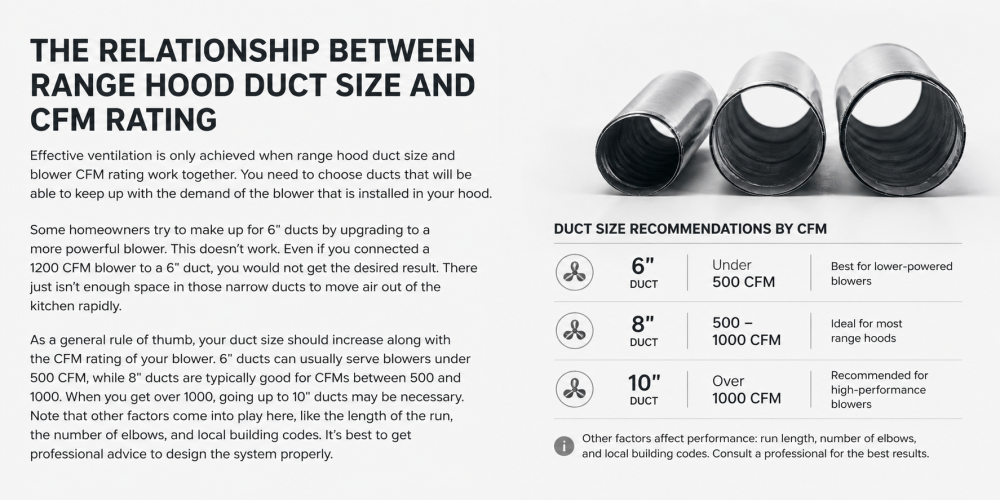
Effective ventilation is only achieved when range hood duct size and blower CFM rating work together. You need to choose ducts that will be able to keep up with the demand of the blower that is installed in your hood.
Some homeowners try to make up for 6'' ducts by upgrading to a more powerful blower. This doesn't work. Even if you connected a 1200 CFM blower to a 6'' duct, you would not get the desired result. There just isn't enough space in those narrow ducts to move air out of the kitchen rapidly.
As a general rule of thumb, your duct size should increase along with the CFM rating of your blower. 6'' ducts can usually serve blowers under 500 CFM, while 8'' ducts are typically good for CFMs between 500 and 1000. When you get over 1000, going up to 10'' ducts may be necessary. Note that other factors come into play here, like the length of the run, the number of elbows, and local building codes. It's best to get professional advice to design the system properly.
A Note on Noise Levels
Everyone loves a quiet range hood. You might think that a more powerful blower would automatically be louder, but duct size actually comes into play here, as well.
Excessive noise from your range hood is often the result of restricted airflow. If your ducts are too small, air velocity increases and turbulence forms. This can cause a whooshing sound that is louder than you would like it to be.
That's not the end of the story. With undersized ducts, your blower will face resistance and have to work harder, meaning it makes more noise and vibration increases. So, the whole system is louder, and it doesn't work as well. All of these frustrations can be solved simply by installing the right duct size from the start.
Find the Ideal Hood at CopperSmith®
The perfect range hood for your luxury kitchen is waiting to be discovered at CopperSmith. Our blend of exceptional materials, unbeatable craftsmanship, and simple customizations puts a gorgeous new hood within the reach of every homeowner. Reach out directly for assistance or browse our range hood collection now to get started.


 By submitting, you agree to our Privacy Policy & Terms