

A considered bathroom remodel begins with a clear scope: what stays, what moves, and what must be repaired before new finishes go in. The most useful budget separates the visible fixtures from the work needed to install them properly.
How much does a bathroom remodel cost? The 2026 U.S. Houzz Bathroom Trends Study reports median bathroom spending of $15,000 for 2025 and $25,000 for major remodels, defined in that report as projects including at least a shower upgrade. These are survey benchmarks, not contractor quotes or minimum budgets.
A cosmetic refresh, a full replacement within the existing layout, and an expanded bathroom are different projects. Location, hidden damage, installation requirements and finish selections can move the final price substantially. Compare bids for the same written scope before settling on a budget.
The original graphics remain throughout this guide. Their older dollar ranges and percentage allocations are historical illustrations with unverified underlying sources, not current estimates. Use the dated research and your project-specific quotes for budgeting.
Understanding Bathroom Remodeling Costs
Your bathroom remodel cost will vary depending on what’s involved. Here are some factors to consider.
What Does a Bathroom Remodel Entail?
A bathroom remodel can entail anything from a simple paint job to breaking down the walls and building a larger bathroom. Here are some common bathroom remodeling endeavors.
- New fixtures such as the sink, toilet, and cabinets: Many households replace existing fixtures when they are no longer functional or stylish. They may also update to more energy-efficient fixtures.
- New plumbing and electrical systems: Plumbing and electrical systems wear out eventually. You may also choose to update systems for a more convenient layout.
- Replacing the sink countertops: New sink countertops can significantly enhance your bathroom aesthetics.
- Adding shelves: Shelving creates more space in small bathrooms.
- Installing safety features such as grab rails: This is a common remodeling endeavor for senior family members.
- Updated Lighting: Lighting is a major factor in bathrooms. You may update your lighting for better mirror views and improved navigation.
- Breaking Down Walls: In extreme instances, you may even break down your bathroom walls to make a smaller or larger bathroom.
- Paint Job: Painting can change the entire look of your bathroom. Consider the latest colors and styles to create an updated look.
- Shower and Shower Doors: Stylish shower doors can improve your bathroom aesthetics. You may also consider switching out an old showerhead or renovating the tub.
- Tiles: You may choose to replace your bathroom wall tile or floor tile to update your bathroom aesthetics. Tiles often get cracked and chipped, and grout can dull and darken. Switch them out to create a clean, modern interior design.
- New Windows: Bathrooms don’t typically have many windows, but you may need to replace yours if it interferes with remodeling needs.
- Permits: Your bathroom remodel may require a permit. This will likely be the case if you update the plumbing or electrical system. Permits are typically inexpensive, but they will increase costs.
Cost and resale value are different measures. The 2025 Cost vs. Value national report models a midrange bath remodel at $26,138, with an estimated $20,915 retained at resale, or 80%. That is a defined project model, not a promise of a return on an individual home. It also differs from a homeowner survey median.
Contractors and homeowners use “renovation” and “remodel” differently. A written list of work is more useful than either label.
For comparable estimates, specify whether you are refreshing finishes, replacing fixtures in place, rebuilding the wet area, or changing the footprint. Include demolition, disposal, repairs, installation and finishing in the same scope.

Factors Affecting Bathroom Remodel Costs
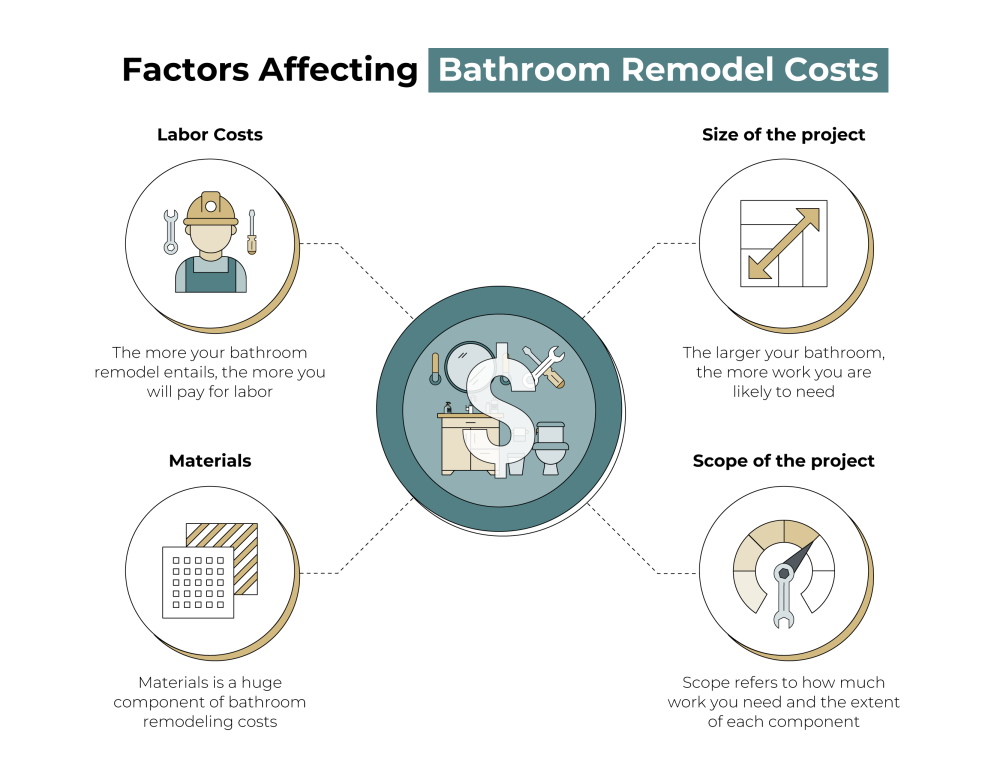
Several factors affect your bathroom remodel cost including the size and scope of the project, and the materials and labor. We’ll break these factors down in the following sections.
Size and Scope of the Project
A larger room needs more surface material, but square footage alone does not price the project. A compact room with relocated drains, intricate tile and custom cabinetry can cost more than a larger room with straightforward replacements.
Scope determines the amount of work: retaining sound plumbing locations reduces one source of disruption, while moving a toilet or shower can affect floors, walls and adjacent spaces.
Start with three lists: required repairs, functional improvements and optional finishes. Resolve leaks and deficient construction before allocating money to decorative upgrades.
Materials and Labor Costs
Material is a huge component of bathroom remodeling costs. There are several materials to consider including the following:
Materials to specify: wall assemblies suited to their location; the complete waterproofing system in wet areas; fixtures and fittings; floor and wall finishes; and compatible paint and trim. A premium surface does not replace sound preparation underneath it.
Labor may be quoted as a fixed contract price, time and materials, or a combination with allowances. Ask which selections are fixed and which remain estimates.
Confirm who pays for demolition, disposal, delivery, permits, inspections and subcontractor coordination. A lower headline bid may simply omit work included elsewhere.
Agree on a change-order process and keep a separate contingency for conditions that cannot be confirmed before demolition. Set its size with the contractor after assessing the building and the proposed work.
Detailed Cost Breakdown
Build the budget around installed assemblies rather than isolated product prices. A shower needs more than tile; a vanity needs more than a sink. Ask each bidder to identify inclusions and exclusions.
Major Components
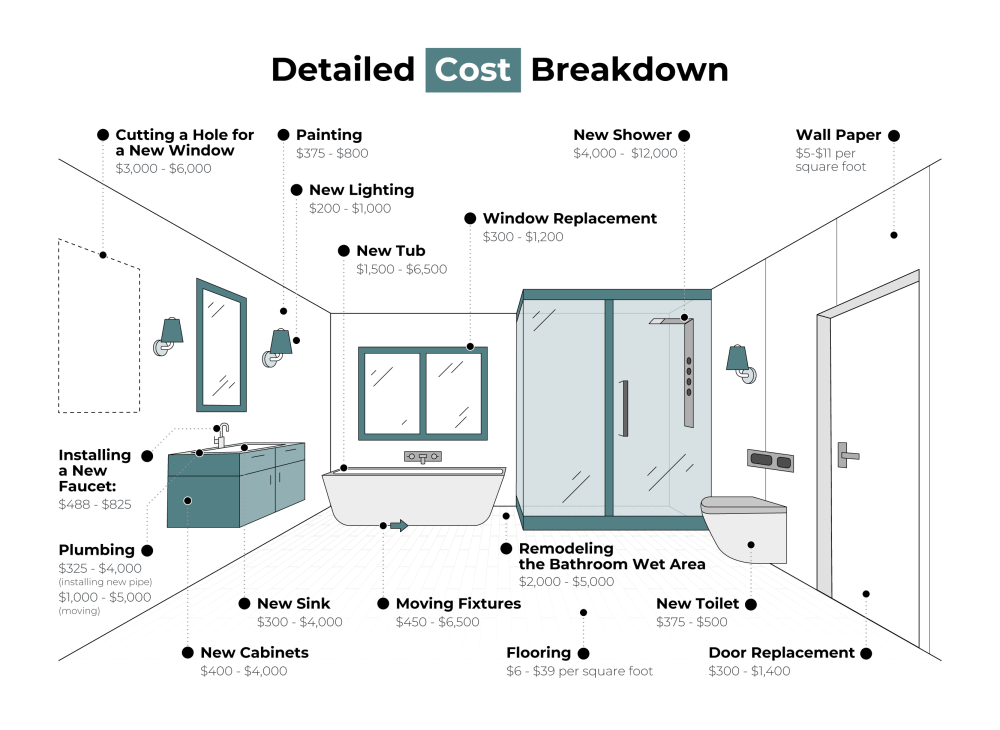
Historical component ranges: the following figures are retained from the original guide for continuity with its graphics. Their source date and labor inclusions were not established. They are not verified current prices; some categories overlap and must not be added together as a project estimate.
- Plumbing: $325 - $4,000 for installing new pipe, $1000 - $5000 to move plumbing
- New Toilet: $375 - $500
- New Sink: $300 - $4000
- New Cabinets: $400 - $4000
- New Lighting: $200 - $1000
- Painting: $375 - $800
- Moving Fixtures: $450 - $6500
- Installing a New Faucet: $488 - $825
- Flooring: $6 - $39 per square foot
- New Shower: $4000 - $12,000
- New Tub: $1500 - $6500
- Remodeling the Bathroom Wet Area: $2000 - $5000
- Wall Paper: $5-$11 per square foot
- Cutting a Hole for a New Window: $3000 - $6000
- Bathroom Door Replacement: $300 - $1400
- Window Replacement: $300 - $1200
Bathroom Remodeling Breakdown
Use an itemized estimate to allocate the budget. A preset percentage can hide expensive wet-area work or double-count contractor charges that are already included in installed prices.
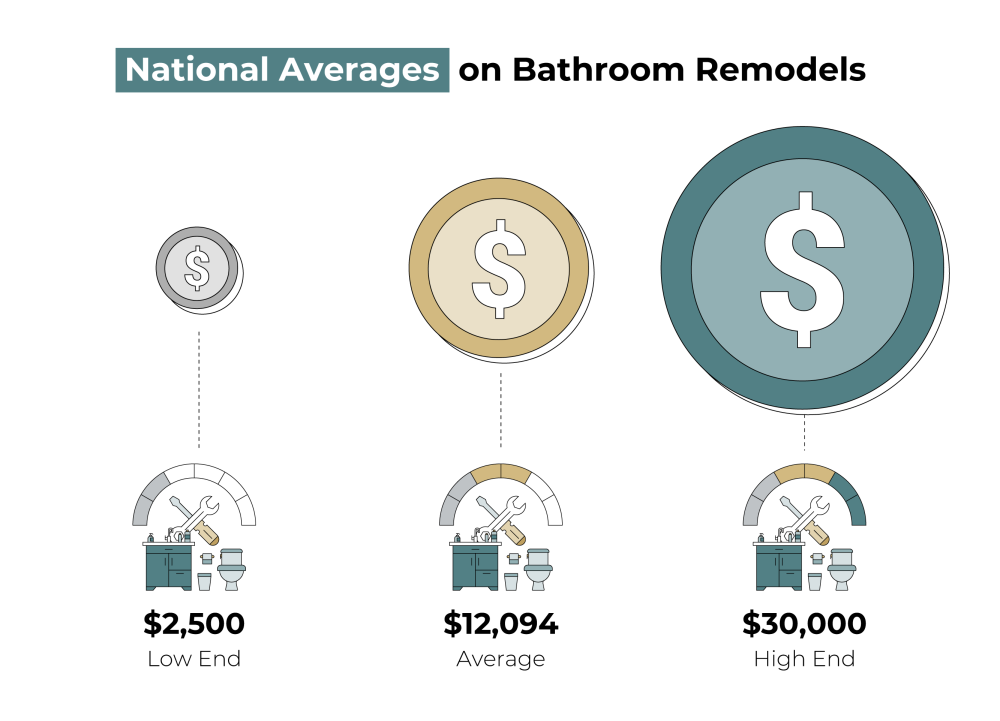
Historical figures from the original guide, not current national averages: the earlier article listed the amounts below without a verifiable dataset. In particular, $30,000 is not a ceiling for a full or custom remodel.
- Average: $12,094
- Low End: $2500
- High End: $30,000
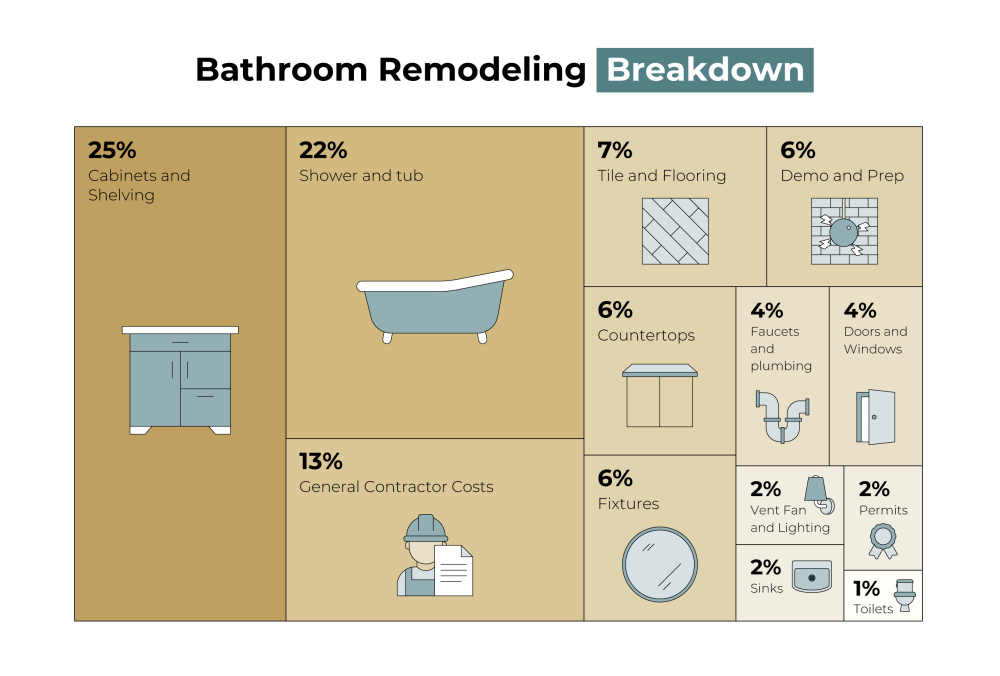
Original illustrative allocation: these percentages total 100%, but they are not a verified industry standard. Do not apply them to a contractor quote without reconciling overlapping categories.
- Cabinets and Shelving: 25%
- Shower and tub: 22%
- General Contractor Costs: 13%
- Tile and Flooring: 7%
- Countertops: 6%
- Fixtures: 6%
- Demo and Prep: 6%
- Faucets and plumbing: 4%
- Doors and Windows: 4%
- Vent Fan and Lighting: 2%
- Sinks: 2%
- Permits: 2%
- Toilets: 1%
A useful estimate lists quantities, selected products, installation, allowances, exclusions and taxes. Track the amount already committed as well as the amount still available.
For example, a hypothetical $24,000 construction contract plus $4,000 of separately purchased fixtures, $2,000 for design and permit-related costs, and a $3,000 reserve creates a $33,000 planning total. This is arithmetic to illustrate budget structure, not a market estimate. Avoid counting fixtures twice if the contract already includes them.
If the total exceeds your limit, simplify the scope before reducing essential preparation. Retaining a workable layout, using a simpler tile pattern or keeping sound cabinetry may be more useful than changing every finish.
Request a separate price for each optional upgrade so you can see what it actually adds to the project.
Specific Bathroom Types and Their Costs
Your bath remodel budget will also vary if you are remodeling a half bath or a primary bathroom. Find out the characteristics of each.
Half Bath vs. Primary Bathroom
A half bath, or powder room, has a toilet and sink, without a bathtub or shower. “Primary bathroom” describes the bathroom serving the primary bedroom; it does not require a separate tub and shower.
A half bath avoids a shower or tub assembly, but custom finishes, plumbing changes and building conditions can still make it a substantial project.
A small floor area reduces some material quantities. It does not eliminate trade visits, mobilization, permits where required, or minimum fabrication charges.
Historical size-based ranges: the original guide listed the following amounts. They are retained as archival reference, not validated quotes. Do not use floor area alone to calculate a renovation budget.
- 25 square foot bathroom: $1800 - $3600
- 40 square foot bathroom: $2800 - $10,000
- 50 square foot bathroom: $3500 - $12,500
- 75 square foot bathroom: $5300 - $18,800
- 100 square foot bathroom: $7,000 - $25,000
However, half baths aren’t always cheaper remodeling projects than full baths. It depends on how far you want to take it and whether you choose luxury elements.

Saving Money and Maximizing ROI
Preserve sound elements that support the new design. Compare the cost of refinishing or adapting them with replacement, and direct spending toward the features you use every day. Cosmetic improvements do not guarantee a particular resale gain.
Alternatively, you may consider compromising on the materials and finishes you use. You may be surprised to find how much these seemingly minor factors add to costs. Here are some to consider.
Countertop Material
Historical material ranges per square foot: the original figures below do not consistently establish whether fabrication, cutouts, edges, delivery or installation are included. Request a complete countertop quote.
- Ceramic $2 - $20 per square foot
- Porcelain: $4 - $30 per square foot
- Laminate $9 - $30 per square foot
- Granite Slab: $20 - $140 per square foot
- Marble: $30- $200 per square foot
- Quartz: $50 - $175 per square foot

Compare the installed countertop assembly. Material price alone does not capture the cost of sink cutouts, seams, supports or a small-job fabrication minimum.
Bathroom Flooring
Historical flooring ranges per square foot: these figures are not verified current installed prices. Confirm substrate preparation, removal, waterproofing where required, and the exact product’s suitability for the location.
- Ceramic Tile: $1 - $12 per square foot
- Porcelain Tile: $3 - $6 per square foot
- Granite: $5 - $15 per square foot
- Marble Tile: $10 - $25 per square foot
- Laminate Flooring: $1 - $12 per square foot
- Vinyl Flooring: $2 - $ 17 per square foot
- Hardwood Flooring: $6 - $25 per square foot

Ceramic tile may not be your first option, but it’s a solid go-to for households who wish to stay within budget on their bathroom or kitchen remodeling project.
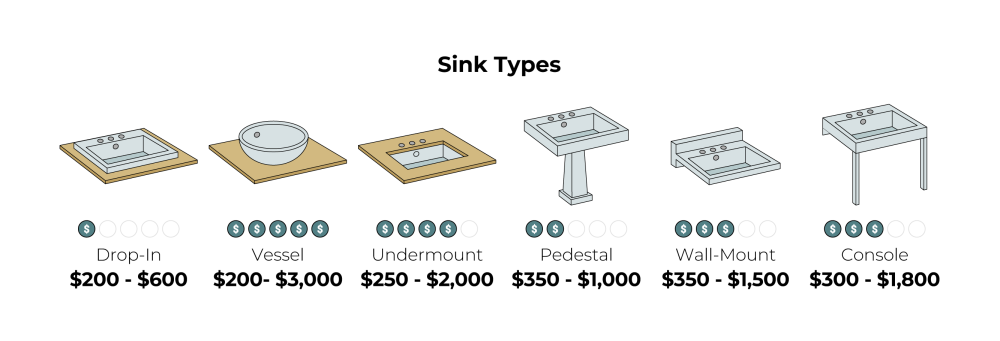
Sink Type
Historical sink ranges: these are not CopperSmith quotes and do not establish installation inclusions. Compare the basin with the cabinet, counter fabrication, faucet and drain work it requires.
- Drop-In: $200 - $600
- Vessel: $200- $3000
- Undermount: $250 - $2000
- Pedestal: $350 - $1000
- Wall-Mount: $350 - $1500
- Console: $300 - $1800
For a custom metal sink, coordinate the finish and dimensions before the counter is fabricated. CopperSmith’s DV1 is an undermount double-vanity design with configurable bowl finish, texture and gauge; the product page lists 48-, 54- and 60-inch widths. Confirm the selected configuration, cabinet clearance, support, faucet reach and drain arrangement with your installer. A sink price alone is not the installed vanity cost.
Toilet Types
Historical toilet ranges: the categories below mix construction styles, flushing systems and features; they are not mutually exclusive. Confirm the selected model’s rough-in, supply and electrical requirements and the installed total.
- Low-Flow Toilets: $125 - $640
- Two-Piece Toilets: $165 - $425
- One-Piece Toilets: $300 - $600
- Wall Hung Toilets: $350 - $600
- Double Cyclone Flush Toilets: $400 - $600
- Smart Toilets: $1000 - $2000

Compare verified water-use specifications and maintenance needs as well as purchase price. Wall-hung systems and powered features may require additional work that is absent from a fixture-only price.
Tub and Shower Styles
Historical tub and shower ranges: the original list mixes product types and scopes. A hot tub is not equivalent to a bathroom soaking tub, and a shower kit price is not the cost of a finished shower.
- Premade Shower Kit: $500 - $1500
- Tub-Shower Combo: $700 - $8000
- Walk in Shower: $8500 - $20,000
- Clawfoot/Freestanding Tub: $700 - $11,000
- Hot Tub: $1300 - $14,000
- Walk-in tub: $1800- $12,000

For a freestanding bath, include the filler, drain and overflow configuration, delivery route, installation access and any necessary floor assessment in the planning discussion. Resolve these details before closing walls or ordering surrounding finishes.
Conclusion
A strong bathroom budget connects the room’s design to its construction. Establish the work first, price complete installations, and make finish decisions while changes are still straightforward.
Keep the estimate, selections and schedule together. Record the allowance for each unfinished decision and require written approval for changes that affect the total.
Spend deliberately on proportion, practical storage and the surfaces you touch each day. A well-coordinated sink or bath should belong to the room, with its installation considered as carefully as its appearance.
FAQs
What are some signs that I need a bathroom remodel?
Persistent leaks, damaged finishes, inadequate storage or a layout that no longer supports the household are reasons to assess the room. Have moisture problems investigated before choosing cosmetic updates; new finishes alone do not resolve their cause.
Should I choose luxury fixtures?
Choose premium fixtures when their function, proportions and finish matter to your daily use. A luxury remodel should be budgeted for those priorities. Its full cost may not be recovered at resale, regardless of the neighborhood.
Should I DIY My Bathroom Remodel?
Painting and selected finish work may suit an experienced homeowner. Plumbing, electrical work, structural changes and wet-area construction require the right competence and any locally required licensing or permits. Include rework risk when comparing DIY with a professional installation.
What are the Benefits of a Bathroom Remodel?
Potential benefits include better circulation, usable storage, improved lighting and a more coherent design. The result depends on what the project actually addresses.
Moisture and efficiency: investigate and correct the source of dampness rather than covering it. Water or energy savings depend on the fixtures, systems and use patterns; neither a remodel nor a new finish guarantees them.

Where Can I Find Bathroom Remodeling Ideas?
Several resources will inspire your bathroom remodel. You may look at interior design magazines and websites for ideas. You can also talk to your contractor or a designer. They will offer inspiration and bring your ideas to life.
Which budget categories should I price first?
Start with repairs, plumbing and electrical changes, and the complete wet-area assembly. Then price cabinetry, counters and fixtures. This exposes essential construction costs before optional selections use up the budget.
What is a realistic budget for a bathroom remodel?
Begin with the dated national benchmarks above, then obtain local quotes for your actual scope. A survey median describes a group of past projects; it does not establish what your bathroom will cost today.
What is the most expensive part of a bathroom remodel?
The wet area can be a major cost because it combines demolition, substrate work, waterproofing, plumbing, surfaces and often glass. It is not always the largest item: structural changes or custom cabinetry can dominate another project.
Can you remodel a bathroom for $5000?
A $5,000 limit may support selected cosmetic changes or individual replacements when existing conditions are sound. It should not be assumed to cover a complete professional rebuild. Price the essentials before committing.
How much does it cost to remodel a bathroom with a tile shower?
Ask for separate totals for the shower assembly and the rest of the bathroom. The shower quote should include demolition, preparation, waterproofing, plumbing, tile installation and any enclosure. A tile material price is not a complete shower price.
Can you renovate a bathroom for $10,000?
Some limited projects can fit $10,000, especially if the layout and major assemblies remain. That budget does not reliably cover replacing every fixture, rebuilding the shower and repairing hidden damage. Confirm the scope with written bids.
Are one day shower remodels worth it?
A rapid installation may suit a compatible replacement system and sound existing conditions. Ask what the advertised day includes, how hidden damage is handled, and whether planning, fabrication, curing and inspections sit outside that window.
How do people afford bathroom remodel?
Set an affordable project limit and separate essential work from optional changes. A staged refresh may be possible when the retained work is sound. If considering financing, compare the full repayment cost and terms before committing to the project.
What comes first in bathroom remodeling?
Begin with an assessment, measured layout, written scope and budget. Coordinate fixtures and obtain any required approvals before demolition. The contractor can then sequence demolition, rough work, wet-area preparation and finishes.
How long does it take to remodel a bathroom?
Ask for both the construction schedule and the full project timeline. Design, approvals, product lead times, inspections, curing and unforeseen repairs can all affect the completion date. A short installation estimate is not the same as the time from first selection to finished room.
What is a good budget for a small bathroom remodel?
A small bathroom still requires many of the same trades as a larger one. Price the selected scope locally and distinguish a powder-room refresh from a shower rebuild. The historical size ranges above are not reliable current budget targets.
Why are bathrooms so expensive to renovate?
Several trades work within a small area, often in a strict sequence. Preparation, waterproofing, plumbing, electrical work and finish installation all contribute; relocating fixtures or repairing hidden damage adds further work.
How much does it cost to remove a bathtub and install a walk-in shower?
Request an installed conversion quote that includes removal, disposal, the new drain arrangement, preparation, waterproofing, fixtures, surfaces and enclosure. Accessibility goals or changes to the floor can alter the scope substantially.
How much does a small walk-in shower cost?
Compare a complete installed prefabricated system with a complete custom assembly. Small size does not remove the cost of skilled labor, preparation, waterproofing and plumbing connections.
Does a tile shower increase home value?
A well-executed shower may improve buyer appeal, but no specific resale increase follows automatically from using tile. Condition, design, local expectations and the rest of the property all matter.
What is the most affordable shower remodel?
Keeping a workable layout and comparing a compatible prefabricated system with tile can reveal savings. Panels are not always the lowest installed cost; compare preparation, labor, fittings and enclosure on the same basis.
Are bathroom remodels worth it?
Judge the project by everyday use, necessary repairs and your plans for the home. The dated resale model cited earlier does not show full cost recovery for its midrange bathroom project, and an individual result can differ.
Does replacing a bathtub with shower devalue house?
The effect depends on the household and local buyers, including whether another bathtub remains. The earlier claim that showers add a specific dollar amount compared with tubs was not supported by the cited project-value data. Discuss resale priorities locally before removing the home’s only tub.
Why is replacing a shower so expensive?
A replacement may involve more than visible surfaces: demolition, drain work, repairs, substrate preparation, waterproofing, valves and a new enclosure. Ask which of these tasks is included in the quote.
Should I replace bath with walk-in shower?
Choose based on bathing needs, access and the room’s layout. Water use depends on duration and flow, not simply the presence of a shower. EPA WaterSense showerheads use no more than 2.0 gallons per minute. At that flow, an eight-minute shower uses 16 gallons; compare that calculated example with the actual volume of a bath rather than assuming a fixed percentage saving.
How often should showers be replaced?
There is no universal replacement interval. Assess leaks, drainage, damaged joints, failing finishes and whether the shower meets the household’s needs. Repair or replacement should follow the condition of the assembly, not an arbitrary anniversary.
 Start your project →
Originally published October 21, 2024. Updated November 4, 2026. Research checked November 11, 2026.

 By submitting, you agree to our Privacy Policy & Terms