

An everyday-use assessment of copper tables, covering material behavior, weight, hygiene, maintenance, room fit, and the tradeoffs worth considering.
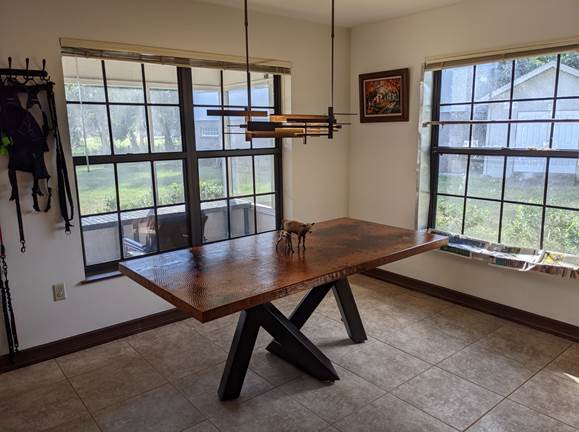
Copper connects the table surface with the warmer tones in the room. Base position and chair clearance deserve the same attention as the finish.
Copper tables can be practical when the construction and finish suit the way you use them. They are not automatically lightweight, scratch-proof, maintenance-free, or less expensive than other tables. Compare the complete piece, protect the surface appropriately, and decide whether changing tone and visible use fit your expectations.
Copper tables offer a material surface with warmth and variation. Living with that surface is a more useful consideration than a general promise of durability. Think about the objects, activities, and movement your table will encounter each day.
A dining table used only for meals has a different brief from one that also handles homework, equipment, or craft supplies. Evaluate the finish, support, dimensions, and care around those tasks, then compare the complete table against your alternatives.
Material Benefits: Separate Useful Qualities From Assumptions
Copper can give a room a substantial material presence without requiring an ornate form. A simple top can relate to timber or contrast with stone and fabric. Texture and patina allow different expressions, but those choices should be approved as part of the actual table specification.
Durable does not mean immune to marks. Contact with grit, sharp objects, or moving equipment can affect the surface or its protective treatment. A patinated appearance may accommodate variation visually, while a more uniform finish may make a new mark stand out. Compare examples of expected aging before choosing.
The absence of iron-oxide rust does not mean copper cannot react with its environment. The Canadian Conservation Institute’s metal guidance describes different corrosion behavior across metals. For furniture, ask how the entire table is protected and maintained rather than relying on a single material claim.
Weight and Moving: Check the Whole Assembly
Do not assume copper furniture is light. Total weight depends on the dimensions, metal construction, substrate, and base. A large top with a substantial support can need a planned delivery and more than one person for safe handling.
Before ordering, measure the delivery route, including doors, stairs, turns, and lift access. Ask which parts arrive assembled, who handles final assembly, and how the top should be lifted. A removable base can help access only when that method is designed and approved.
If you move furniture frequently, discuss glides and flooring protection. Lift the piece using the approved method instead of dragging it. The base and connection details matter as much as the appearance of the top.
Hygiene and Maintenance: Expect a Normal Routine
A finished copper table does not remove the need for cleaning. EPA guidance on antimicrobial copper products describes specific registered surfaces and treats their action as supplemental to normal hygiene. Do not assume the same performance for a table or its coating.
Plan for everyday protection: clear residues promptly, keep hot cookware on trivets, and use suitable mats for writing or craft work. Ask which cleaning products are approved for the finish. If a household needs a particular disinfecting routine, have its compatibility checked before selecting the surface.
Keep instructions where the people cleaning the table can find them. A finish that one person understands can still be damaged when someone else applies an ordinary abrasive cleaner. Clear care expectations are part of making the table practical.

A copper surface in a covered outdoor setting. Exterior suitability depends on the complete assembly and approved finish, not the metal surface alone.
Room Fit: Shape the Table Around People and Movement
The right shape depends on the room, seating, and circulation. A rectangular table can relate to a long room; a round top may work differently around a compact seating group. Neither is automatically the correct choice without checking the space around the chairs.
Consider the base footprint and underside, not just the top. A pedestal, trestle, or crossed support can affect where feet go and whether a chair can tuck in. Compare the table-base options and clearance considerations before setting the final dimensions.
Bring a chair into the sample review when possible. Check arm height and the relationship between the seat, underside, and edge. Use the table and chair sizing guide for additional planning, and confirm the final setup with the actual furniture.
Cost and Value: Compare Like With Like
Copper is not automatically cheaper than wood, glass, or stainless steel furniture. Compare the complete specification, including fabrication, finish, dimensions, base, delivery, and installation. A material name alone does not establish the cost of the finished piece.
Value depends on whether the table remains useful and welcome in the room. Ask about maintenance, finish repair, replacement components, and the support available if something is damaged. Do not treat patina as a guarantee of resale value or a substitute for a suitable construction.
For an initial design comparison, review the Industrial ID1 metal dining table with the copper configuration in mind. Use the product as a starting point for discussing requirements, not as proof that every possible dimension or finish is available.
A Quick Practicality Test
Write down three things you do at the table most often and three things you are least willing to maintain. If your priorities include a fixed color, an unmarked writing surface, or frequent hot cookware without protection, discuss those requirements before choosing copper.
If material variation appeals to you and a modest protection routine is realistic, copper may fit well. Ask for the approved construction and care details, then make the final choice alongside the actual room materials.
- Confirm the assembled weight and delivery plan.
- Check chair fit and circulation at the intended size.
- Review finish change, cleaning, and repair expectations.
- Compare the complete quotation against alternatives.
Common questions
Are copper tables lighter than steel tables?
Not necessarily. The size, thickness, substrate, and base determine the weight of the finished piece. Ask for the actual handling weight.
Are copper tables scratch-proof?
No. Surfaces and coatings can be scratched. Some color changes may soften the appearance of a mark, but physical damage does not disappear automatically.
Can a copper table be used for meals and homework?
Yes, if the specified piece suits both uses. Plan for placemats, a writing mat where needed, and a cleaning routine appropriate to the finish.
Updated October 29, 2026. Originally published 2015-01-08. Care and suitability depend on the selected product and finish.
Define the details around your space.
Bring the activities, dimensions, chair information, and maintenance expectations that matter to your household. Choose the material around that brief.
Review copper table options
 By submitting, you agree to our Privacy Policy & Terms