Guides / Materials
304 vs. 316 Stainless Steel:
Which Is Better Outdoors?
The difference is corrosion resistance. The right choice depends on what the metal will face.
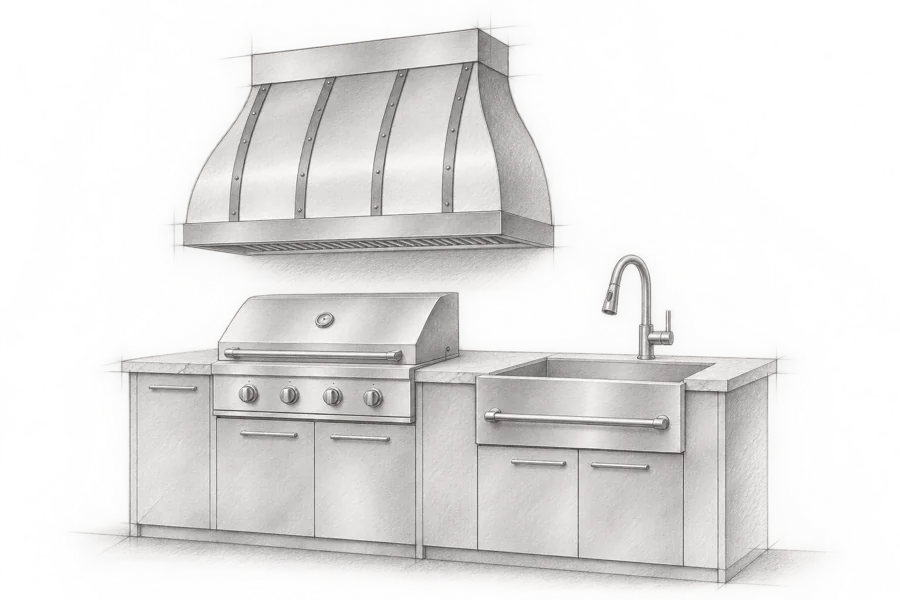
304 vs. 316, at a glance
304 General-purpose stainless
A practical candidate for many mild inland settings. Consider it where salt exposure is limited and the design allows appropriate cleaning and drainage. [1]
316 Greater chloride resistance
An upgrade for added chloride resistance. Consider it for coastal exposure or an inland project where that extra resistance is a priority. Molybdenum helps improve its corrosion resistance. [11]
Neither is maintenance-free. Grade, surface finish, construction details and exposure work together. A water-filled vessel or a complete cooking appliance also needs its own specification. [10]
01 / Match the metal to the use
One outdoor space.
Several different material decisions.
A BBQ hood meets outdoor air. A sink also meets water and food residue. A plunge holds treated water. A fire pit combines an exterior enclosure with a separate combustion system. Calling all four “outdoor stainless” skips the part of the conversation that matters.
| Application | 304 can be considered | When to evaluate 316 | Confirm separately |
|---|---|---|---|
| BBQ hood exterior | Mild inland exposure with suitable care. | Coastal salt or other chloride exposure. | The complete hood's suitability for the grill and location. |
| Outdoor kitchen sink | Mild exposure, compatible water and cleaners, and effective drainage. | A more chloride-exposed setting or water-contact environment. | Bowl, apron, drain and fittings, not only the visible face. |
| Cold plunge / hot tub | Only as part of a validated vessel and water-treatment specification. | Often worth evaluating for chloride resistance; not automatic approval for treated or heated water. | Water chemistry, temperature, disinfection and all wetted components. |
| Fire pit enclosure | A suitable exterior design in a mild setting. | Salt exposure affecting the enclosure. | Burner, fuel system and installation requirements. |
CopperSmith's application-based synthesis of exterior and pool materials guidance [1, 4, 7, 10]. These are selection prompts, not certifications of a product or installation.
Can I choose 316 for a Midwest home?
Yes. You can choose additional corrosion resistance even where 304 would be adequate. If the proposed product can be supplied in 316 and the added cost fits your project, it is a reasonable material upgrade to discuss with the supplier.
Inland exposure can include winter deicing salts, so location alone does not tell the whole story. [6]
316 is not the highest-performing stainless alloy in every environment. More resistant alloys exist, and 316's mechanical characteristics are broadly similar to 304. Finish, fabrication and the complete product still matter. [3]
Concept residences illustrate the design possibilities. The alloy grade and intended use are specified separately for each product.
02 / The outdoor kitchen
304 or 316 for an outdoor BBQ hood?
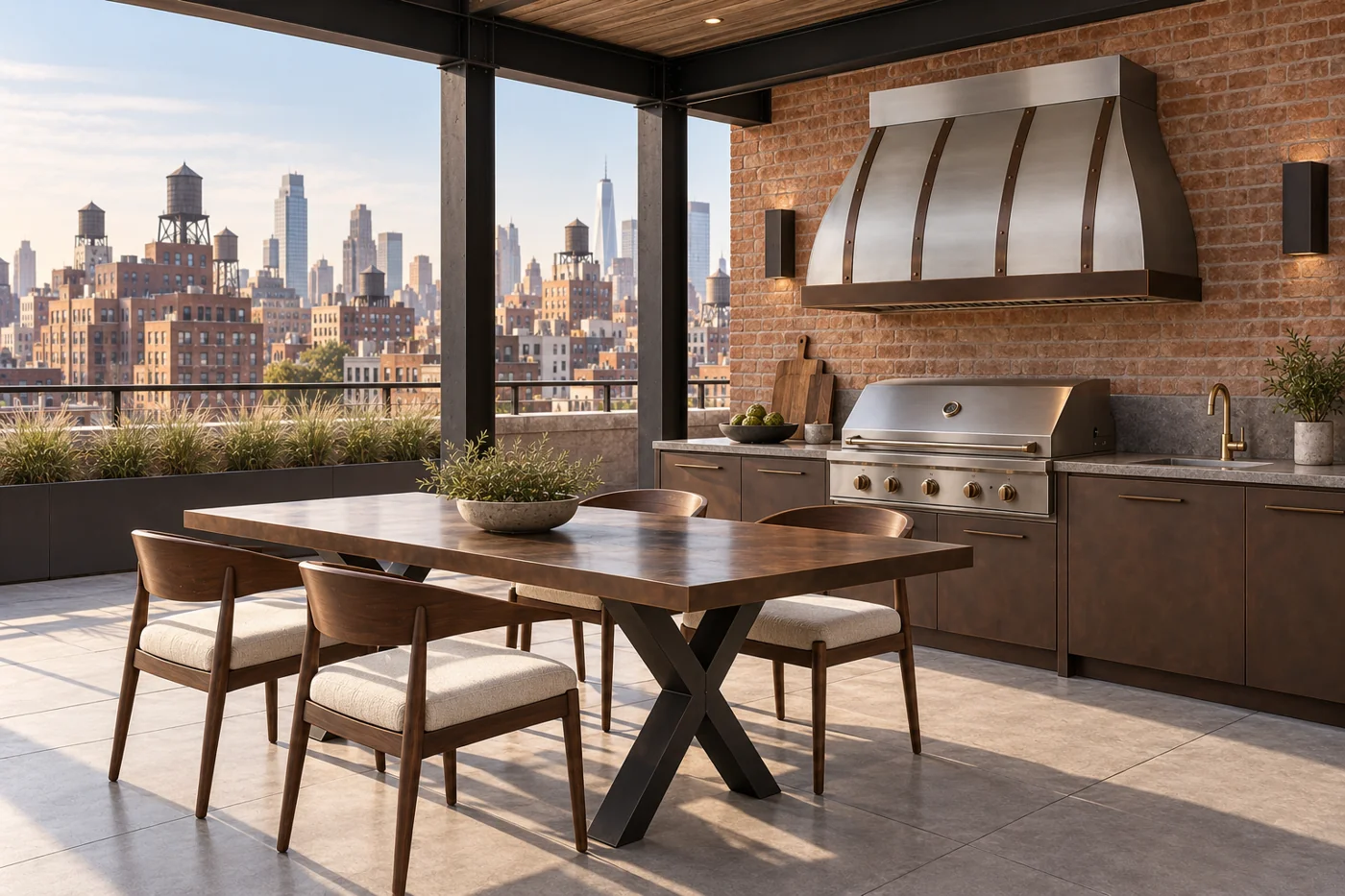
Concept residenceA stainless hood with bronze accents anchors this rooftop kitchen. The stainless hood body is the material reference here. Explore the residence.
Choose for the setting
For an inland kitchen with limited salt exposure, 304 may be appropriate. Near the coast, evaluate 316 for the exposed stainless components. The outdoor location alone does not settle the grade. [1]
A roof is not a salt barrier. Sheltered surfaces can collect deposits without being rinsed by rain, so include the hood's underside, seams and accessible trim in the cleaning plan. [5]
Then resolve the hood system
The Foundry House scene uses an Artisan AT3-inspired form. For an actual grill, begin with CopperSmith BBQ range hoods and the appliance requirements. Confirm capture dimensions, installation height, exhaust equipment and the intended outdoor configuration.
Ask: “Which parts are stainless, what grade is proposed, and is this complete hood configuration suitable for my grill?”
03 / Water, preparation, cleanup
Which stainless steel belongs in an outdoor sink?
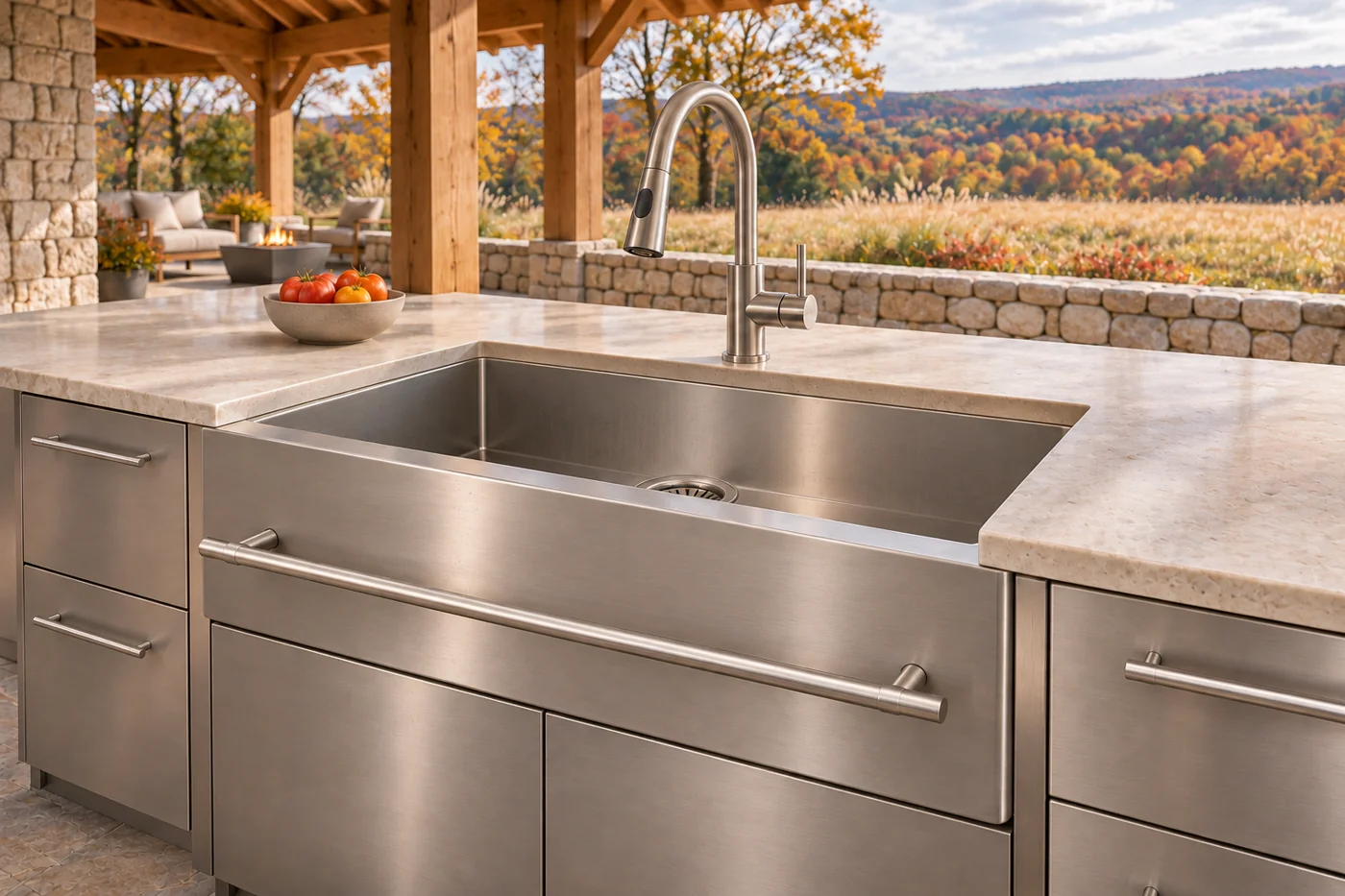
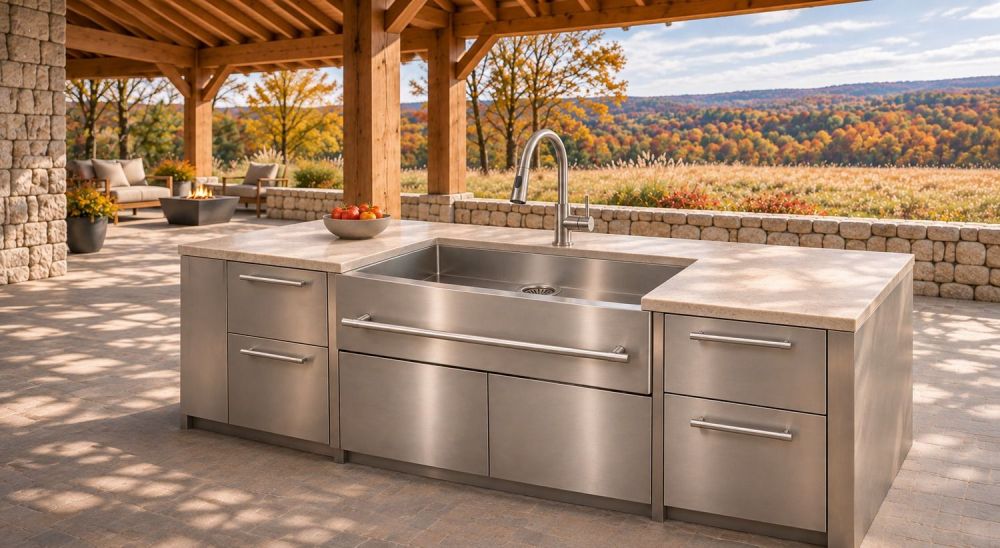
Concept residenceAn outdoor interpretation of the Farmhouse ST towel-bar sink pairs a broad stainless apron with stone and timber. The alloy grade and outdoor configuration are specified for the project.
The bowl deserves its own specification
Meadowline's indoor kitchen supplies a useful product reference: the Farmhouse ST towel-bar sink. In the outdoor adaptation above, the broad apron, single bowl and rail keep the same design language. Moving that idea outside adds a material-selection question.
An outdoor sink combines atmospheric exposure with repeated wetting. Molybdenum improves resistance to localized chloride corrosion, but water-contact conditions and the details that hold moisture still matter. [4]
Describe the water as well as the weather
Identify the water supply, cleaning products, proximity to pool splash and the way the bowl will drain. Ask which grade is proposed for the bowl and which materials are used for the apron, drain and hardware. One visible stainless surface does not describe the whole assembly.
Ask: “Is this sink configuration intended for my outdoor setting, and what care does each component require?” Explore stainless steel sinks.
04 / The wellness terrace
Cold plunges and hot tubs:
specify the water-contact system.
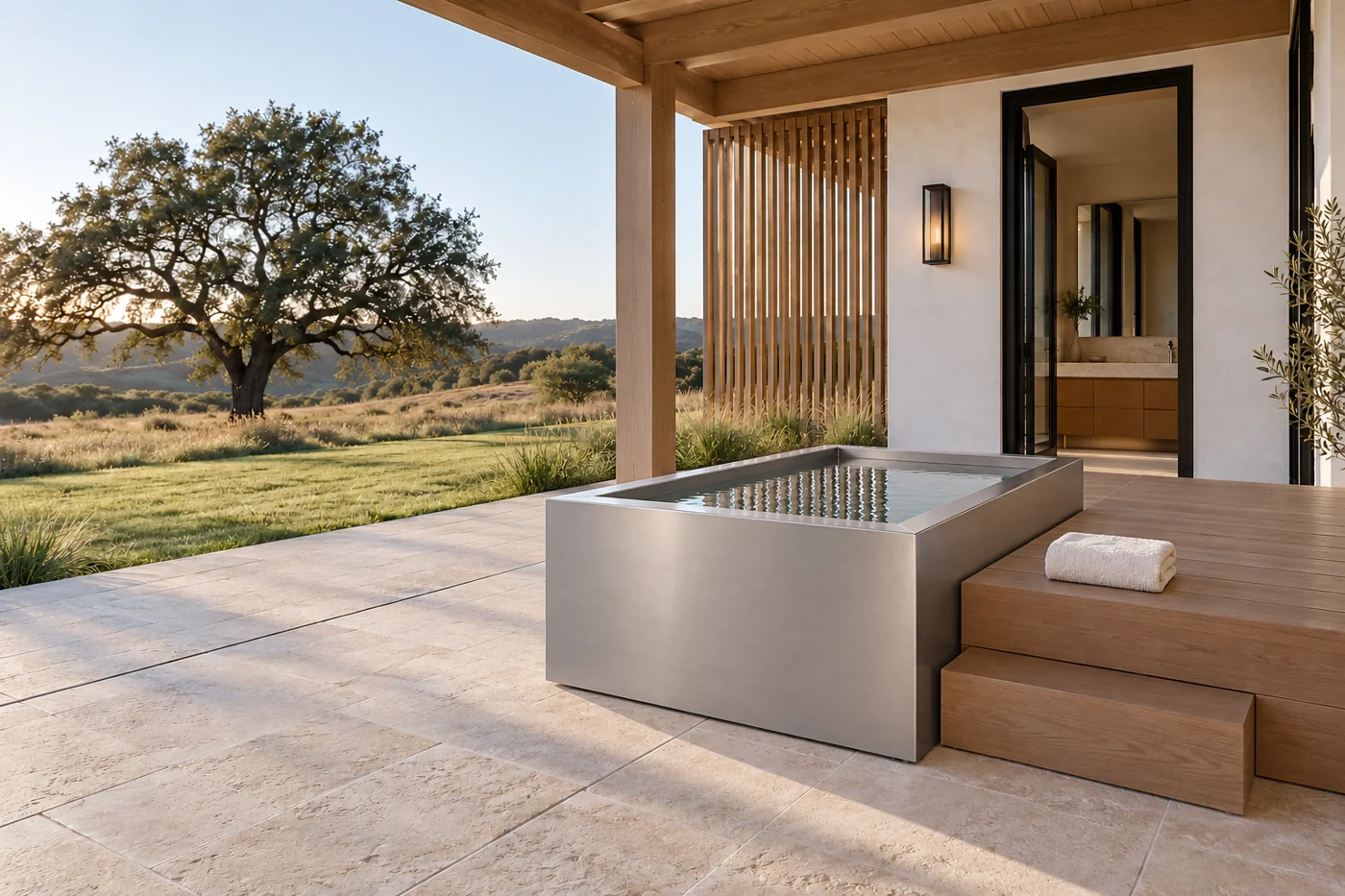
Concept residenceThe outdoor stainless cold plunge at Oakfield House sits beneath a timber canopy. Although copper appears elsewhere in this residence, this wellness feature is stainless.
316 is a candidate, not a complete answer
Pool-industry guidance often favors 316 over 304 for resistance to staining, pitting and crevice corrosion. It also treats different components and exposures differently. That guidance does not certify a particular plunge or hot tub. [7]
More aggressive chloride conditions can challenge 316 too. A higher grade number is not permission to use any water treatment, temperature or cleaning chemical. [3]
Ask for a coordinated vessel specification
For a custom cold plunge or a heated soaking concept, document the intended water temperature, treatment method and operating routine. Have the vessel and equipment suppliers confirm the compatible water-contact materials, connections and maintenance requirements together.
Ask: “Which components touch the water, and what written water-chemistry and operating limits apply to this complete system?” A shell drawing or a residence image cannot answer that question.
05 / The gathering space
Does a stainless fire pit need 316?
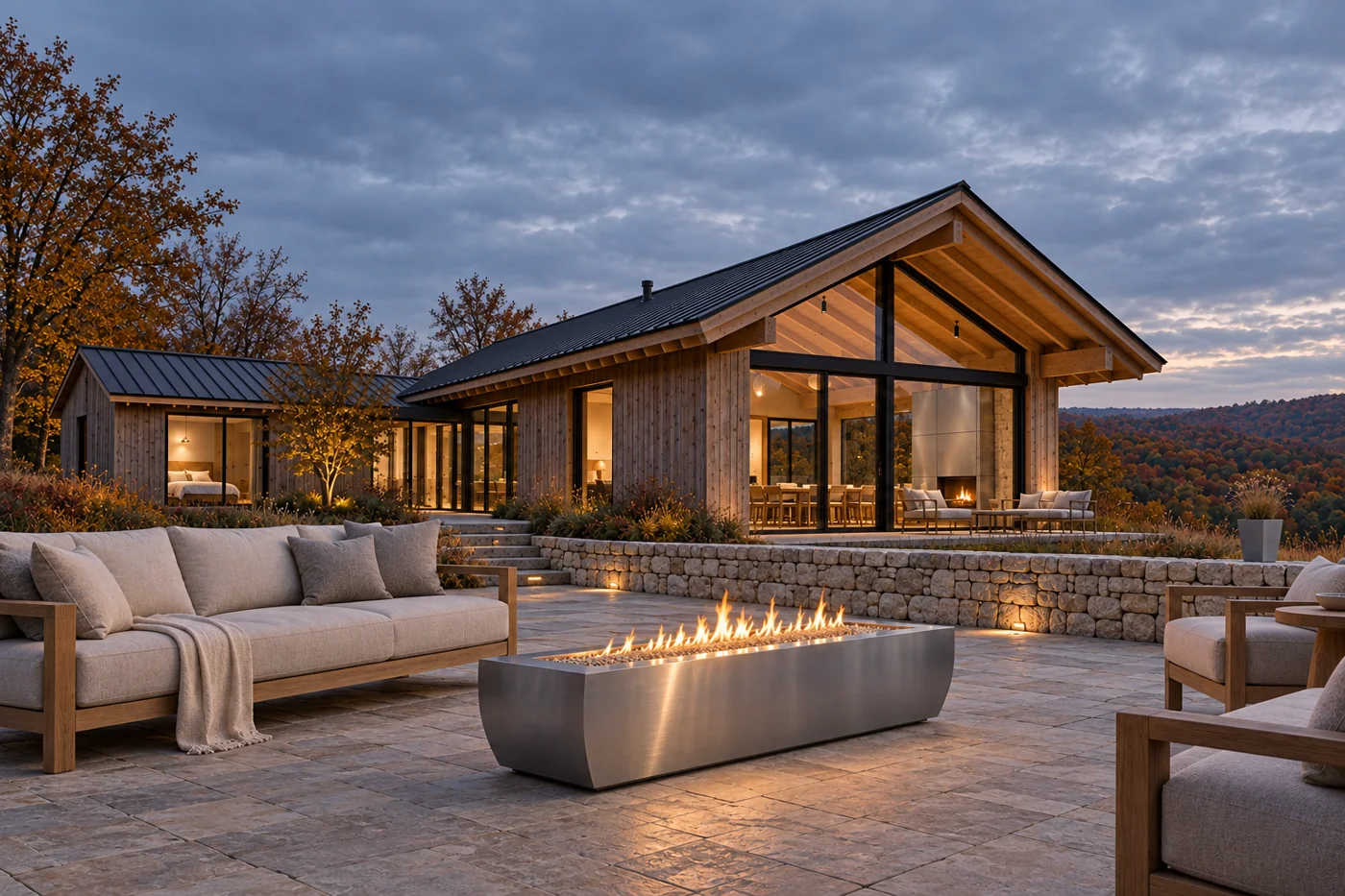
Concept residenceThe Convex Rectangular Fire Pit appears in a stainless finish on Meadowline's stone terrace. See the full residence.
Stainless enclosure, solid-brass burner
The exterior body makes the architectural statement: a low silver volume between timber seating and stone paving. Its grade should be evaluated against the site's corrosion exposure.
CopperSmith's Convex Rectangular Fire Pit can pair a stainless enclosure with a solid-brass burner. The enclosure's 304 or 316 grade and the burner's material are separate parts of the specification. Fuel, ignition and installation requirements still apply to the complete system. [15]
316's advantage over 304 here is not an automatic increase in heat capability. Their heat-resistance characteristics are similar; an alloy description is not a fire pit's operating rating. [3]
Include inland salt exposure
A terrace does not have to face the ocean to encounter chlorides. Deicing salt can affect nearby outdoor metal, so tell the design team about treated walks, driveways and tracked or splashed salt. [6]
Ask: “What grade is proposed for the enclosure, and which burner and fuel configuration is specified for this installation?” Explore fire pits.
06 / A useful distinction
A stainless exterior does not identify the bathing well.
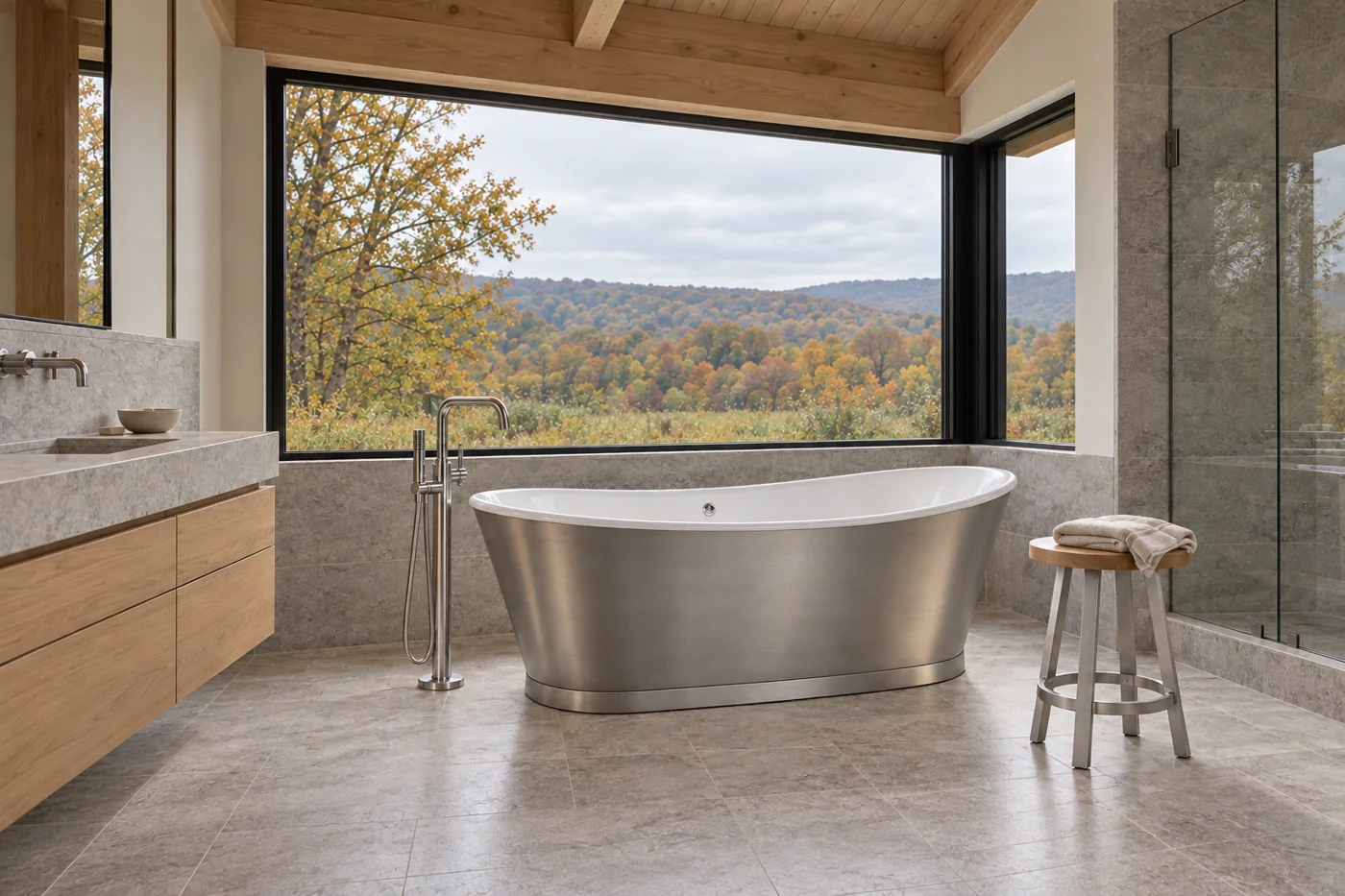
Concept residenceThe residence's Limited LS1 bathtub pairs a stainless exterior with a cast-iron bathing well. This is an indoor bath reference.
A material name can describe the exterior, the structure or the surface that touches water. Those are different parts of the specification.
Meadowline's LS1 is a clear example. Its silver outer skin does not make the bathing well stainless steel. For an outdoor bath, plunge or hot tub, identify the water-contact construction first, then review the exterior material and the complete system's intended use.
Conceptual section of a clad bath, not an LS1 fabrication drawing. Layers are exaggerated to explain the distinction; no thickness or assembly details are specified.
07 / Beyond the number
Grade, finish and care are three separate choices.
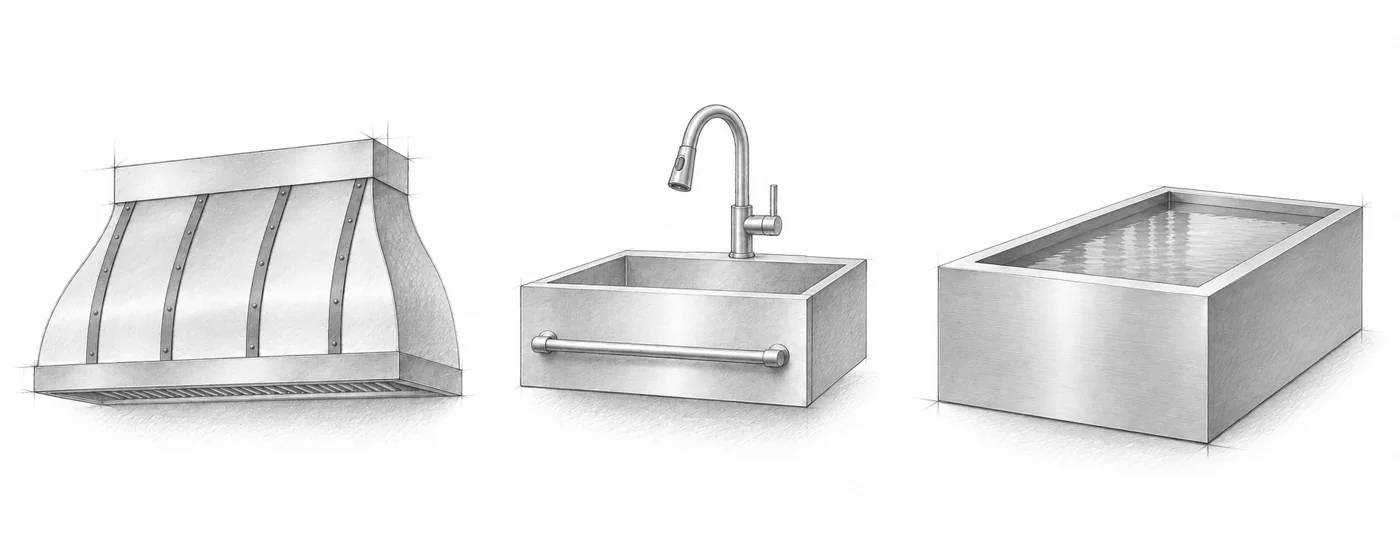
Grade is alloy chemistry. Both 304 and 316 are chromium-nickel stainless steels; 316 typically includes 2–3% molybdenum. Finish describes the surface, while thickness describes the material dimension. A thicker sheet or a brushed finish does not establish that a piece is 316. [2]
Appearance is not a grade test. Ask for a written material designation and appropriate supporting documentation. Color, shine or a simple magnet check cannot reliably establish the exact grade of a finished product. [8]
Details affect the result. Roughness, trapped deposits, sheltered areas and iron contamination can contribute to staining. A brown mark does not, by itself, identify either the alloy or the cause. [5]
Choose the appearance with CopperSmith finishes and physical samples; record the grade separately. Keep that same distinction when specifying a stainless furniture base, planter or architectural panel.
How should outdoor stainless steel be cleaned?
For routine cleaning, follow the product's care instructions and use compatible mild detergent, clean water and a soft cloth. Rinse residues away and dry accessible surfaces. Avoid carbon-steel wool, hydrochloric-acid cleaners and chlorine bleach unless a product-specific procedure explicitly permits it. Never combine cleaning chemicals. [9]
Set the inspection and cleaning frequency around the exposure rather than promising one schedule for every home. Salt-exposed and sheltered surfaces may need particular attention. Severe exposure or persistent corrosion warrants a materials specialist's assessment. [10]
08 / When the exposure asks more
What if 316 stainless steel is not enough?
Start by reviewing the cause. Deposits, surface condition, fabrication and maintenance can contribute to corrosion even when the nominal grade looks appropriate. Changing the alloy alone may leave the underlying detail unresolved. [5]
For more aggressive chloride conditions, duplex 2205 or a higher-alloy stainless containing 6% molybdenum may be evaluated. These are specialist material choices; 316L is a low-carbon variant, not the next level of chloride resistance. [3]
Regular seawater splash or immersion can require still more resistant grades, including super duplex stainless. A corrosion specialist should evaluate the exposure and construction together. No single replacement grade suits every environment. [10]
When should you consider copper, brass, titanium or another alloy?
Choose the material for the part and its purpose. A decorative hood skin, a sink bowl and a heat exchanger can justify different choices within the same project.
| Material | When it makes sense to evaluate it |
|---|---|
| Copper | Hood exterior, cladding or architectural panel. Consider it when warm color and a developing patina are part of the design. Confirm the finish, exposure and surrounding materials. [12] |
| Brass | Hood straps, trim or decorative hardware. Consider it for a golden accent that connects the metalwork to other details. Specify the actual alloy and finish, not color alone. [12] |
| Higher-alloy stainless | Chloride-exposed components where 316 is insufficient. A specialist may evaluate duplex, super duplex or higher-molybdenum stainless grades against the actual exposure. [10] |
| Titanium | Specialist water-contact equipment, such as heat-exchanger tubing. Its resistance in many seawater and chloride conditions can justify evaluation when stainless is unsuitable. Grade, temperature, chemistry, crevices and connections still need review. This is not automatic approval for a complete tub or plunge. [14] |
These are component-level selection prompts, not a universal ranking of metals or a statement that every material is available for every CopperSmith product.
Copper and brass are not automatic corrosion upgrades from 316. Some brasses can lose zinc in unsuitable water conditions, a process called dezincification. Water-contact uses need their own material specification. [13]
Check the connections too. Titanium joined to another metal in a conductive liquid can accelerate corrosion of the less resistant partner. Have the designer evaluate the metal pairing, isolation and joint details; replacing only the visible part may not solve the problem. [14]
Choose the exterior's appearance with metal and finish samples, then confirm the material for each working surface and component. A decorative shell and a treated-water vessel perform different jobs.
09 / Beyond the designed home
Where else are 316 and 316L used?
The 316 family has a broader role in equipment and manufacturing. These examples give context for the alloy choice without turning an industrial application into a claim about a residential product.
| Industry or use | Examples |
|---|---|
| Food and beverage | Selected food and beverage processing equipment. [3] |
| Pharmaceutical manufacturing | Pharmaceutical processing equipment. [11] |
| Chemical processing | Chemical equipment, tanks and evaporators. [11] |
| Industrial equipment | Heat exchangers, valve components and pump trim. [11] |
Industry examples are drawn from ASSDA and steel producer Cleveland-Cliffs [3, 11]. Exact grade, finish, fabrication and service conditions are specified for each application. These uses do not establish pharmaceutical, food-contact or other certification for a CopperSmith product.
A better project brief
Five things to specify before choosing 304 or 316.
Use this checklist with your designer or product supplier. It keeps a conversation about “stainless” attached to the piece you actually intend to build.
- The component. Name the hood body, sink bowl, bathing well, exterior cladding or fire pit enclosure. List separately specified fittings and equipment.
- The exposure. Describe coastal salt, deicing salt, pool splash, shelter and the surrounding environment.
- The water or appliance system. For a vessel, document water treatment and temperature. For cooking or fire, identify the appliance and its installation requirements.
- The material and finish. Request the proposed grade for each relevant component, the surface finish and appropriate material documentation.
- The care plan. Confirm compatible cleaners, access for maintenance and the written operating limits of the complete product.
“We are planning a stainless [product] for [setting]. Please identify the grade by component, the intended operating conditions and the care requirements for this configuration.”
Common 304 vs. 316 questions
Is 316 always better than 304?
It offers greater chloride resistance, but 304 can be appropriate in mild settings. Specify the exposure and use first; “outdoors” alone is not enough to choose. [1]
Can 316 stainless steel rust?
Yes. It can stain or corrode under unsuitable conditions. Grade selection, surface condition, fabrication and care still matter. Persistent marks deserve investigation rather than a diagnosis from color alone. [5]
What does 316L mean?
The L identifies a lower-carbon version, often specified to reduce sensitization concerns associated with welding. It does not mean a different decorative finish or immunity to corrosion. [3]
Does “marine grade” guarantee suitability for a hot tub?
No. A broad material label cannot establish suitability for a specific treated-water system. Confirm the vessel, fittings, water chemistry and operating requirements together. [7]
Does 316 look different from 304?
You cannot reliably distinguish them by appearance. A finish sample helps choose the look; documentation or suitable material testing establishes the grade. [8]
How close to the ocean do you need 316?
There is no single distance that settles every project. Salt exposure varies with the site, local conditions, shelter and maintenance. Use the actual exposure rather than a universal coastal mileage rule. [10]
From the material to the whole space
Bring the setting into the specification.
A stainless hood, sink, bath or fire feature should belong to the architecture and suit the way it will be used. Bring CopperSmith your product idea, site conditions and finish direction so the conversation can begin with the relevant details.
Sources & methodology
Materials guidance is drawn from technical associations, metal producers and the National Park Service. The application table and project checklist are CopperSmith editorial syntheses, not product certifications. No laboratory testing or independent engineering review is claimed. Images are labeled as concept residences; material grades are specified separately.
- British Stainless Steel Association — Selection of stainless steels for building external applications
- Specialty Steel Industry of North America — Technical Resources
- Australian Stainless Steel Development Association — 316: The First Step Up
- International Molybdenum Association — Molybdenum Grade Stainless Steel FAQ
- Australian Stainless Steel Development Association — Preventing Coastal Corrosion (Tea Staining)
- worldstainless; Catherine Houska — Deicing Salt — Recognizing the Corrosion Threat
- British Stainless Steel Association — Stainless steels for swimming pool building applications: selection, use and avoidance of stress corrosion cracking
- Australian Stainless Steel Development Association — Testing for Grade Confirmation
- British Stainless Steel Association — Cleaning methods for stainless steel
- International Molybdenum Association — Which Stainless Steel Should Be Specified for Exterior Applications?
- Cleveland-Cliffs — 316 / 316L Stainless Steel — product data bulletin
- National Park Service — Metals in America: Historic Buildings — Part II, Chapter 15
- Association for Materials Protection and Performance — Dezincification
- TIMET (Titanium Metals Corporation) — Corrosion Resistance of Titanium
- CopperSmith - Convex Rectangular Fire Pit, Modern Series: flame-system specifications




 By submitting, you agree to our Privacy Policy & Terms