

Choose a range hood by resolving exhaust type, capture dimensions, mounting and ventilation equipment first. Then use the metal, finish and profile to carry those practical decisions into the kitchen’s design.
Five range hood decisions
Exhaust type: outdoor ducting or approved recirculation.
Size: width, depth, capture area and permitted height.
Style: the hood’s form and relation to the kitchen.
Finish: material, tone, texture and care.
Mount: under cabinet, wall or island, with suitable support.
Accessories: select compatible equipment and controls.
Whether you’re building a new kitchen or you’re replacing your microwave with a range hood, you’ll need to make some decisions about your range hood options. If you're still getting familiar with what a range hood does, it's worth understanding the basics before diving into the choices below. These options include selecting the following:
-
Exhaust type
-
Size
-
Style
-
Finish (material)
-
Mount style
In addition, you will need to contemplate any range hood accessories you may want to add to your project. At World CopperSmith, we’re here to guide you through the options selection process.
Range Hood Exhaust Types
Exhaust types
Ducted: captured air travels through a duct to the outdoors.
Convertible: a specific model supports approved ducted and recirculating configurations.
Ductless: filters treat part of the airstream before returning it to the kitchen; heat and moisture remain indoors.
There are three main range hood vent duct options, also known as exhaust types: ductless (ventless), ducted, and convertible.
-
Ductless hoods pass air through specified grease and odor filters, then return it to the kitchen. They do not exhaust heat and moisture outdoors, and filtration does not remove every cooking pollutant. Verify that recirculation is permitted and suitable for the application.
-
Ducted range hoods exhaust captured cooking air outdoors through a dedicated duct. Correct capture geometry, duct size, routing, termination and replacement air all affect the result.
-
Convertible range hoods support more than one approved installation configuration. The exact model may require a recirculation kit or specific filters for ductless use. Choose and install the configuration according to its instructions; do not assume every hood can be converted later.
Configure the range hood
Compare the selected hood’s form, metal, finish and dimensions.
Copper, stainless steel, brass and black or white finishes offer different appearances; verify availability for the selected model.
Use the current configurator and project drawing to review the actual configuration. Model counts and image-resolution claims vary over time.
When comparing the finest premium range hoods, consider depth as well as width. Capture over the front burners matters, and there is no universal 22-inch depth that suits every appliance. Verify the selected hood’s dimensions and installation requirements.
The size you end up with needs to be large enough to absorb the undesirables as you cook but small enough to fit seamlessly between your cabinets (if applicable) and into your overall kitchen design. Traditional range hoods usually have widths of 30″, 33″, 36″, 42″, or 48″.
The hood’s width and depth should meet the cooking appliance and hood instructions. Extra width can be useful, especially at an island, but three inches on each side is not a universal specification. Confirm the permitted mounting height before setting cabinetry.
Do not use a generic electric-versus-gas height range to install a hood. Follow the compatible clearance requirements for both the cooking appliance and hood, plus applicable local rules. Resolve any conflict with the manufacturers and installer before fabrication.
Range Hood Styles
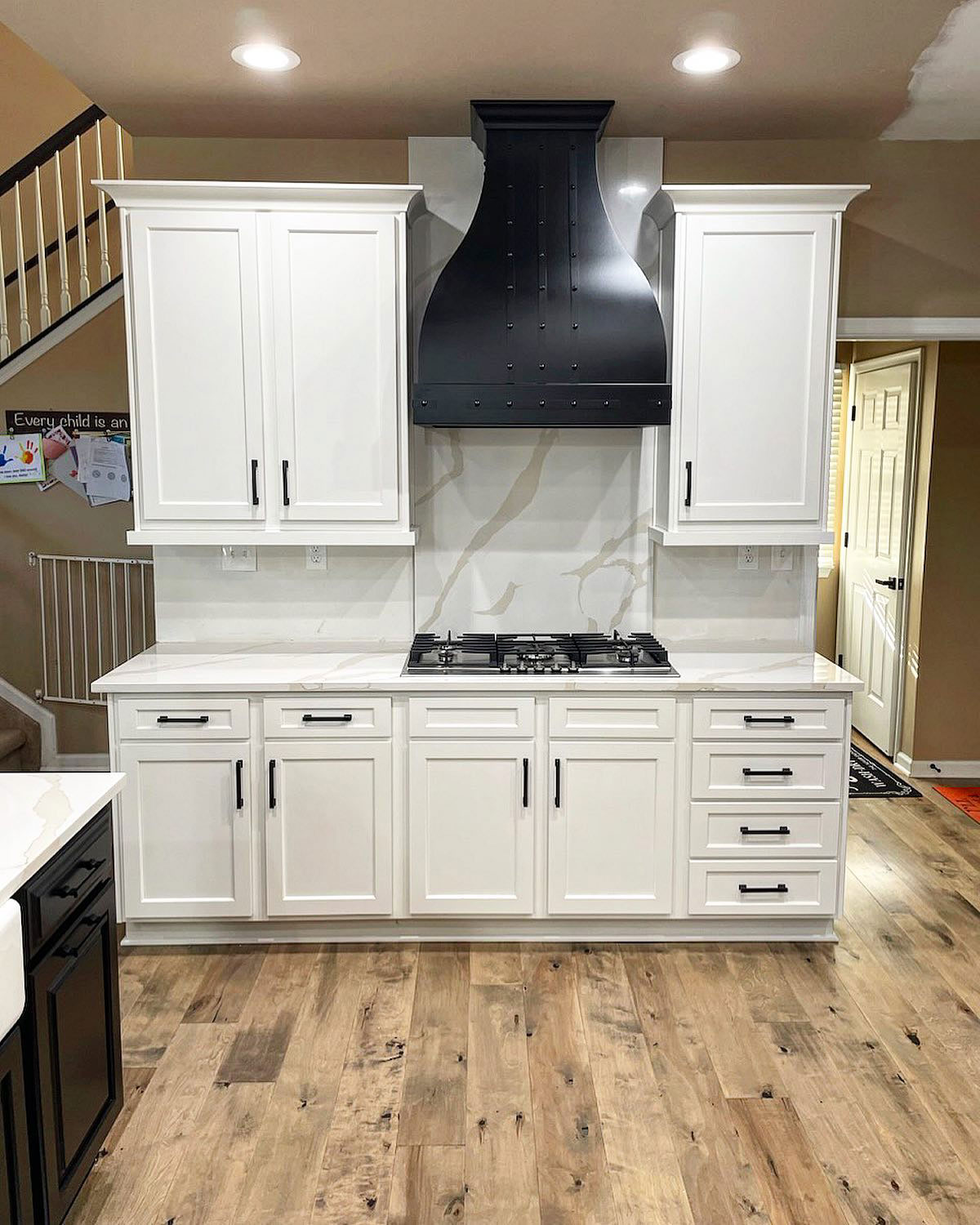
Range hood styles
Modern: simple planes and restrained detailing.
European: traditional proportions and shaped profiles.
Designer: a distinctive form or contrast of trim and body.
Classic (traditional): established proportions and architectural trim.
Artisan: visible texture and crafted details.
Customized: supported dimensions and details resolved for the project.
These are design descriptions; choose the actual model by its drawing and verified options.
There are many kitchen range hood options when it comes to style. For the most part, the hood style you choose should be the same as the style of the rest of your kitchen. However, it’s not unheard of to have a range hood that looks completely different from everything else in a kitchen and still looks fabulous.
Some of the most popular styles of range hoods include:
-
Modern
-
European
-
Designer
-
Classic (traditional)
-
Artisan
-
Customized
Choosing a style for your range hood is a decision that deserves considerable time and thought. After all, a really great range hood usually becomes the focal point and the center of attention in the entire room.
Range Hood Finish
Compare finish families
Metal tone varies with the base material, surface treatment and texture. Compare a physical sample in the room’s light.
Original reference codes — first row: BS, NS, MA, NB, MB, LB, GB, KB, AG, FC, RF, RU.
Second row: AB, DB, NC, WC, NP, OC, RAL9005, RAL9003, RAL1013, RAL3005, RAL5011, RAL6005.
Third row: LA, AC, DA, BZ, RC, BB, RAL7031, RAL9011, PB, PC.
These historical swatch identifiers preserve the original comparison. Confirm current names, availability and appearance with the selected finish sample; screen colors are not a finish specification.
Gone are the days when there were just a few range hood options for finishes Now, there are several gorgeous materials to choose from. Some of these include copper, brass, and stainless steel. Black finishes are also popular for kitchen appliances.
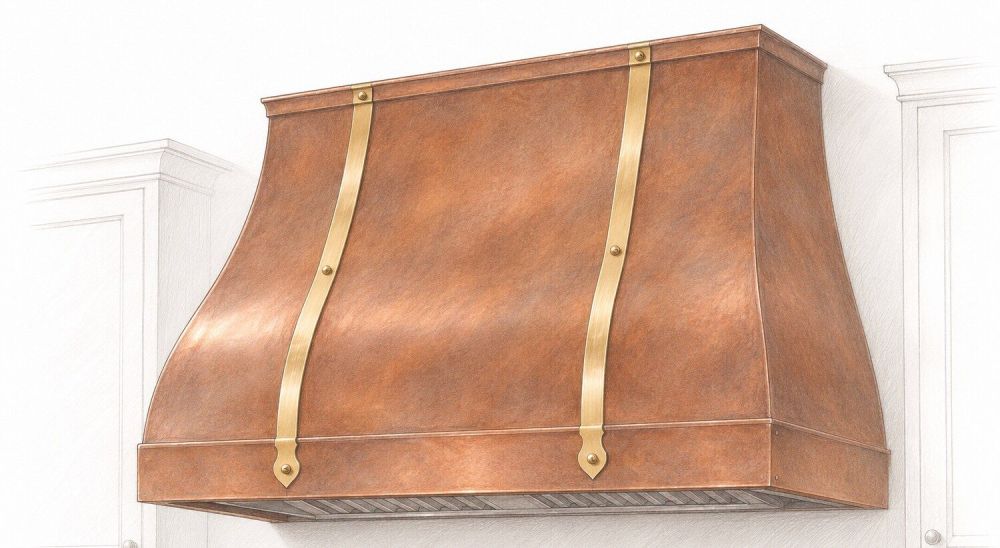
Copper and brass finishes offer a traditional or rustic feel for homes, while stainless and black finishes often are more industrial and modern. Finishes can be mixed and matched for different parts of the range hood, too.
Alternatively, you can choose just one finish. Many people like to select one color for the main body and a different finish for the rivets, pot rail, straps, and crown.
Finish range hood options also include various color choices, and there are literally dozens of colors available, even though many people think of just one “color” for copper, another for stainless steel, and another for brass.
Kitchen Hood Mount Style
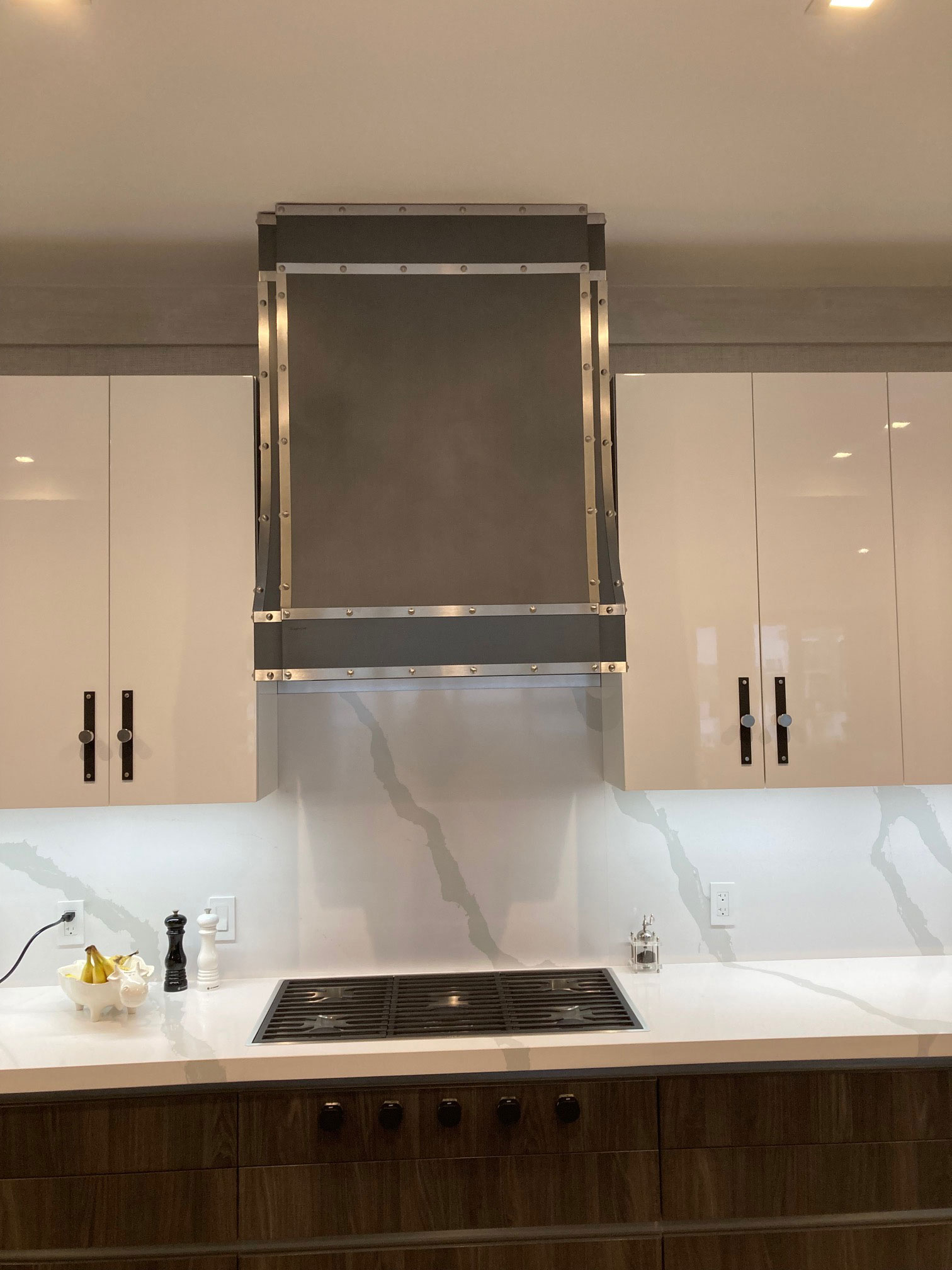
Mounting and potential benefits
Under cabinet: beneath a cabinet, with space for the duct and fixings.
Wall mount: supported from the wall above the cooking appliance.
Island mount: supported overhead above an island cooktop.
Ventilation: evaluate capture and the complete exhaust path.
Aesthetic appeal: relate profile and metal detail to surrounding cabinetry.
Heat: outdoor exhaust carries away some captured heat; recirculation returns air to the room.
There are three main mount styles for kitchen range hoods: under cabinet, wall mount, and island mount.
Under Cabinet Range Hoods
An under cabinet range hood mounts beneath the cabinet above the cooktop. The duct, wiring and mounting provisions can occupy cabinet space, so check usable storage and access rather than assuming the full cabinet remains available.
Wall Mount Range Hoods
Three mounting arrangements
Under cabinet, wall mount and island mount each require suitable structural support.
Choose the arrangement from the cooktop location, then verify clearances, duct routing and service access.
A wall mount hood attaches to suitable wall support above the cooking appliance. Its visible chimney and profile can become a focal point. Set the height from the applicable installation instructions, not a general two-foot rule.
Island Mount Range Hoods
For an island cooktop, island mount hoods hang above an island cooktop and need suitable overhead support and a planned duct route. Exposure to cross-drafts and open edges affects capture; select dimensions and airflow for the actual arrangement rather than assuming one fixed fan increase.
Replacing a microwave with a range hood
Requirements: check the cooking appliance, clearances, capture, duct and electrical supply.
Design: choose whether the metal hood is a focal point or a quieter part of the cabinetry.
Budget: include the hood, ventilation components, removal, finishing and installation work.
Get Your Range Hood Hardware and Accessories From CopperSmith
There are so many options when installing a new range hood. Don’t neglect to consider the various accessories you may want as well.
Accessory availability depends on the exact hood and insert. Options in the wider market include chimney extensions, remote controls, heat sensing, connected controls and lighting. Verify each requested feature on the selected CopperSmith configuration before ordering.
Coordinate the accessories
Check which inserts, controls, lighting and blower accessories are supported by the selected hood.
Keep the ventilation system, electrical supply and service access coordinated with the architectural shell.
Coordinate the selected insert, any compatible blower silencer and nearby pot filler as separate specifications. A BBQ insert must be approved for the appliance and exposure; it is not an interchangeable upgrade for every hood.
When it comes to choosing the very best range hood, the choices are seemingly endless. Start your project today if you have any questions about our range hood options or if you’d like more information about our products.
Choose the insert with the hood
CopperSmith’s integrated wall-mount blower combines variable-speed control, stainless baffle filtration and task lighting in the hood assembly. Those functions belong to the selected equipment; choosing a shell style does not automatically include every accessory discussed above.
Review integrated wall-mount blower for the selected configuration.
Further reading
University of California research examines how hood geometry and airflow affect capture. See capture efficiency.
An AIVC conference paper studies island hood performance. Its test arrangements do not establish a universal residential installation specification. See island hood testing.
Originally published May 8, 2025. Updated November 4, 2026.

 By submitting, you agree to our Privacy Policy & Terms