

A range hood shouldn't sound like a jet engine. Even if it is moving a lot of air, the hood should operate quietly in the background. Time in the kitchen is to be enjoyed without a roaring appliance drowning out your friends and family.
Every range hood makes noise as it runs, but that noise can be kept to a minimum. This post is the primer you need to make smart choices when keeping your hood quiet is a top priority.
The Importance of Controlling Range Hood Noise
With today's open-concept layouts, keeping range hood noise down is more important than ever. A loud hood will not only affect people in the kitchen, but in the living room, dining room, and other gathering areas, as well.
The noise generated by your hood can quickly put a damper on a dinner party or quiet gathering. Even moderate noise levels can interrupt conversation and make it hard to entertain. For that matter, even if you are cooking alone, it's rather annoying to listen to a loud range hood drone on and on while you prepare a meal.
Understand that you don't have to compromise on performance just to keep the sound level down. It's actually possible to use powerful kitchen exhaust fans that still allow for typical conversation to take place in the kitchen.
Understanding Sones vs Decibels
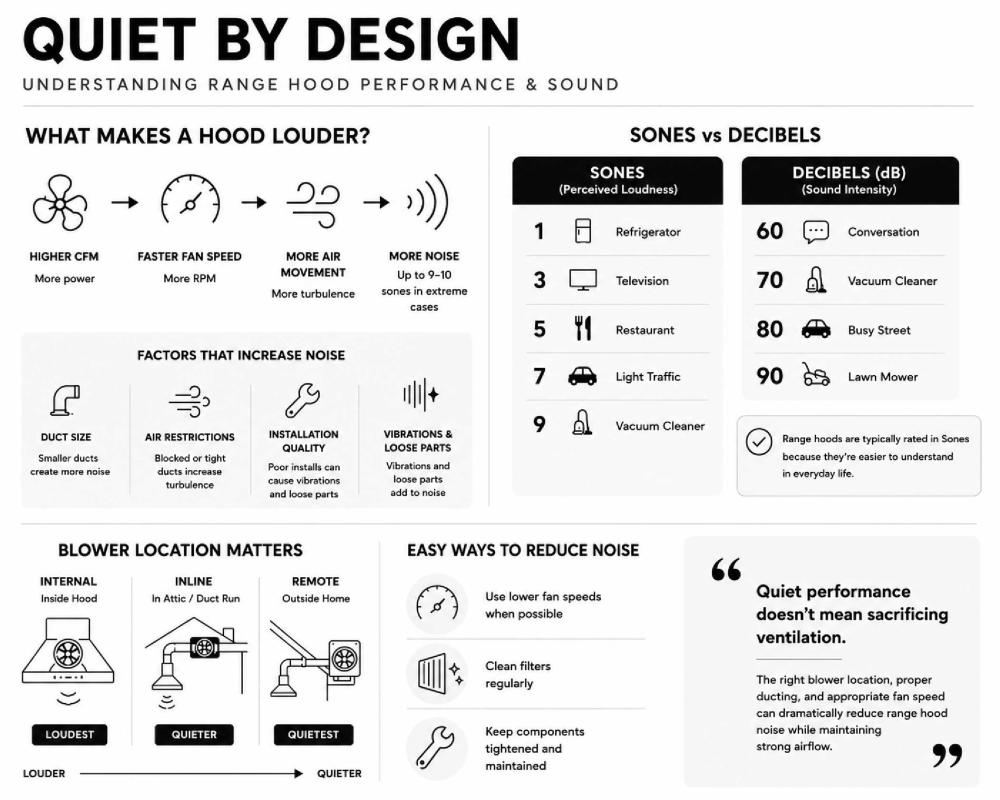
Most people think first of decibels when measuring noise. You've probably heard decibel measurements reported from rock concerts or big sporting events, for example. But decibels aren't the only way to measure noise. In fact, range hoods are typically measured in sones, as they are easier to interpret in this context.
What are Sones?
Sones are a way to measure perceived loudness. The scale is linear, meaning when the sone rating doubles, so does the perceived loudness of a noise. Here are a few examples to help you get familiar with how this scale works -
-
1 sone = the noise level of an average modern refrigerator running
-
3 sones = normal television volume in a living room
-
5 sones = a typical restaurant setting, or a range hood on low
-
7 sones = light traffic, or a range hood on high
-
9 sones = a vacuum cleaner or heavy city traffic
This is a pretty easy scale to understand and relate to during daily life. If you know that the din of an average restaurant is around 5 sones, you can use that as a baseline to know what to expect when a hood fan is rated for a similar noise level.
What are Decibels?
Rather than perceived loudness, decibels are meant to measure sound intensity. The tricky thing about decibels is that they are arranged on a logarithmic scale, rather than a linear one. This means that every 10 dB increase represents a 10-fold increase in perceived loudness.
So, this leads to a scale that is a little harder to interpret. At 60 dB, you have roughly the sound level of normal conversation. Then, just going up to 70 dB leaves you at the level of a vacuum cleaner. That's 10x as loud, only going up 10 dB. This makes it harder to use the decibel scale effectively for things you encounter in daily life, and it's why sone level is an easier option when talking about range hoods.
Higher CFM Often Means More Noise
As you might expect, a more powerful motor is typically going to lead to more range hood noise. This is the case for a couple of reasons. First, you'll be achieving faster fan speeds with a powerful motor, and that fan is going to make noise as it spins.
Also, the increased air movement will contribute its own noise to the equation. When you combine the volume of air that is moving and the mechanical components that are working hard, it's possible to reach nine to ten sones in some extreme cases.
It's important to note that CFM rating is not the only factor in sone level. Several factors also come into play here, including duct size. Smaller ducts will usually lead to louder operation, as a lot of air will be forced through a small space when the hood is running. That can lead to vibrations and loose parts, and you might hear an additional "whoosh" from the rush of the air.
Three Blower Options
The placement of the blower unit in your range hood plays a big role in how much noise it makes. Not all of these blower options will be a good fit for all type hoods, but the three categories below cover most use cases.
Internal Blower
This is the simplest solution for adding a blower to your hood. It is located in the hood canopy, meaning the noise will be coming from directly above the cooktop. This type of blower is affordable and easy to install, but it does usually keep the highest noise level in your kitchen.
Inline Blower
Instead of living in the hood, an inline blower lives in the duct line, usually up in the attic space. The obvious advantage here is that the motor is moved away from the hood, and from the kitchen. Adding the blower to the ducting is a slightly more complicated installation, but it can reduce direct kitchen noise significantly.
Remote Blower
The quietest option for your range hood is to use a remote blower. In this case, the motor is mounted entirely outside of the home, either on an exterior wall or on the roof. This does come with a higher cost, but if you want to keep noise down to the lowest possible level while your hood is running, this is how to do it.
Run Your Hood on the Right Setting
Setting aside the technical details, you can reduce the noise level of your hood simply by using its various settings. The hood doesn't always need to be on high anytime you use the range.
If you are only going to do light cooking, try starting with the hood on its lowest setting. On a low setting, it's possible that a quality range hood will register just one sone as it runs. That means you'll barely hear it and can keep the hood running the whole time you are cooking without any disruption.
Regular maintenance can also prevent your hood from getting too noisy. Having the hood cleaned and all of the parts tightened up will keep it running well and keep the sound to a minimum.
Choose the Ideal Custom Metal Hood at CopperSmith
Every design needs a centerpiece, and in the kitchen, the range hood is a natural choice. When you order from CopperSmith, you'll receive a custom metal hood that has been handcrafted from only the best materials. This piece will command attention and stand the test of time. With questions, or to get started, please contact our team today.


 By submitting, you agree to our Privacy Policy & Terms