

High ceilings open up countless possibilities. With so much vertical space to work with, your creativity can run wild without any limitations.
Perhaps nowhere is that more true than with your range hood selection. By partnering with CopperSmith to design a custom hood crafted with premium metals, you can create a centerpiece that will immediately grab attention. Pay attention to a few key factors in the planning phase and the finished product is sure to turn heads.
Range Height Should Not Be Compromised
Let's start with the key rule that can't be broken in this situation. Even with a tall ceiling, you do not want to move the hood higher up just to fill the space. For a gas cooktop, you'll want to place the hood 30'' to 36'' above the top of the cooking area, regardless of ceiling height.
If you place the hood higher, you'll quickly lose performance. When homeowners mount range hoods too high, they reduce capture efficiency, meaning the amount of the cooking plume that is pulled into the hood. Even a powerful hood will have a hard time capturing smoke, heat, and steam if it is too far above the cooktop.
What is a Chimney Extension?
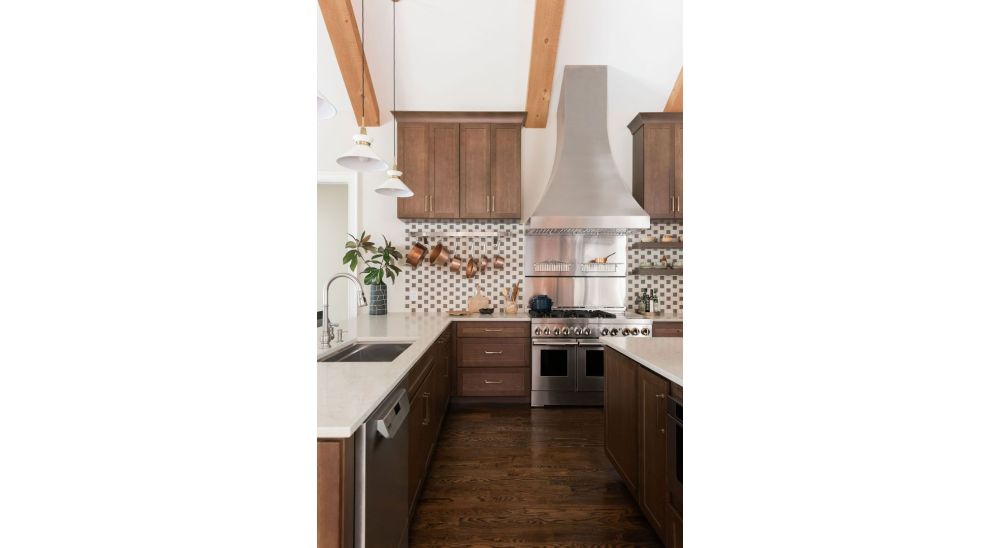
So, if the hood can't be placed higher, you'll need another way to take up the space. This is where a chimney extension can be so useful. This is a vertical enclosure that connects the body of the hood to the ceiling in your kitchen.
In a kitchen with standard ceilings, the chimney extension may be short and barely noticeable. Or, for a hood installed under upper cabinets, it may not be present at all. It's when your ceilings reach the 10' - 12' range and beyond that chimney extensions play a critical role.
The chimney allows you to hide ducting as it heads up to the ceiling. You won't want that duct exposed from the top of the hood body, so a chimney is the natural solution.
Getting the Proportions Right in Tall Spaces
In addition to hiding your vent duct, using a chimney helps you get the proportions in your kitchen design just right. A big space demands a large range hood installation to not look out of place. Using the same hood that looks great in an 8' kitchen in a 12' space isn't going to have the same effect.
During the design phase, keep balance at the top of your priority list. Balance starts with the hood being the same width, or slightly wider, than the cooktop. You'll also want the depth to look right compared to nearby cabinetry.
Then, when adding a chimney, make sure the length is just right to look appropriate above the hood body. A relatively small hood body connected to a very long chimney run would look awkward. The same can be said for a huge hood with a little chimney. Work through design iterations until you strike a nice balance of the various proportions involved.
Dealing with Vaulted or Sloped Ceilings
In large, luxury kitchens, the ceiling is often vaulted or sloped. This is great for visual interest, but it complicates things for range hood installation. You'll need the top of your hood (or chimney) to match the slope of the ceiling to have a seamless finished product.
Working with a custom fabricator like CopperSmith is a huge advantage in this situation. We can create a hood that precisely meets your expectations and will follow the slope of the ceiling exactly. And, by choosing one of our stunning metal options like copper or stainless steel, you'll receive a hood that is both beautiful and durable.
High Ceiling Kitchens May Need More CFM
A high ceiling means the hot air coming off your stove has a long way to travel. The grease, smoke, and moisture carried by that air need to get outside to avoid polluting your kitchen. Looking at various size options and upgrading the cubic feet of air per minute that your hood can move should lead to better performance.
This is particularly true for ceiling mount hoods over an island. Island hoods face an uphill battle because there is an exterior wall to help contain smoke and steam. Also, if you have large windows that you like to leave open, that can create a draft that further complicates matters. There is free space and air currents all around, so the ceiling mount range hood you use needs to be up to the challenge.
A Few Design Options to Consider
There is no denying that high ceilings offer challenges for range hood design and successful venting. But they also offer tremendous opportunities. With a little creativity and a little help from a custom manufacturer like CopperSmith, you can do something extraordinary with this piece.
Bold Metal Continuity
One design option is to carry the same finish from the range hood body all the way up to the ceiling. For example, you could choose our Artisan AT2 custom range hood in the New Penny finish and with a smooth texture. Taking that finish up to your vaulted ceiling will reflect light beautifully and make a bold statement.
Mixed Finishes
Alternatively, you could choose to mix finishes to add visual contrast. That might mean using a hammered finish on part of the hood body while using a smooth finish on the chimney, for instance. There are endless options for creating a customized hood that will take advantage of your vertical space nicely.
Adding Decorative Rivets and Banding
Decorative touches like rivets or banding present an opportunity to dress up your range hood even further. Smooth banding straps can lend a contemporary feel where bold rivets in a hammered finish might bring an industrial feel. These subtle styles help to break up a long vertical run and engage the eye to further the desired effect.
The Sky is the Limit at CopperSmith
High ceilings might introduce complexity to this project, but we are up to the challenge. CopperSmith has helped countless customers design perfect range hoods for high ceiling kitchens, and we'd love to assist you next. Explore our hood options now or get in touch with our team for expert assistance.

 By submitting, you agree to our Privacy Policy & Terms