

Range hoods are usually mounted against a wall. In the case of an island, of course, that won't work. With no wall around, the ceiling is your only mounting option. Let’s break down the basics of sizing island hoods for ideal performance and aesthetics.
Why Island Hoods Require Precision Planning
The ventilation system in a wall mounted hood enjoys a distinct advantage. It has a wall behind the cooktop to act as natural containment. This makes capturing the cooking exhaust easier.
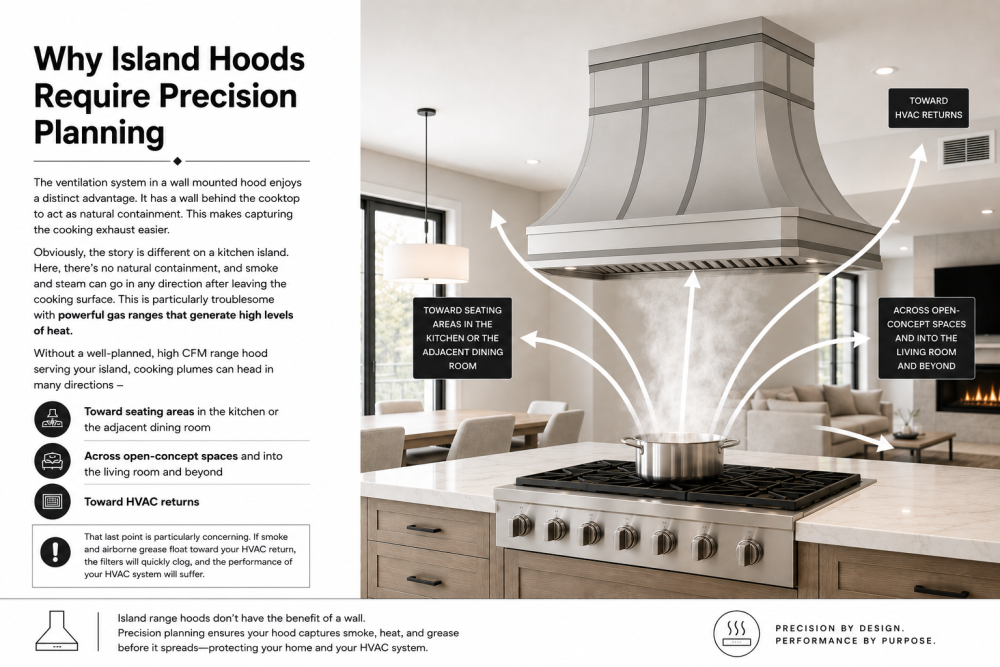
Obviously, the story is different on a kitchen island. Here, there’s no natural containment, and smoke and steam can go in any direction after leaving the cooking surface. This is particularly troublesome with powerful gas ranges that generate high levels of heat. Without a well-planned, high CFM range hood serving your island, cooking plumes can head in many directions -
-
Toward seating areas in the kitchen or the adjacent dining room
-
Across open-concept spaces and into the living room and beyond
-
Toward HVAC returns
That last point is particularly concerning. If smoke and airborne grease float toward your HVAC return, the filters will quickly clog, and the performance of your HVAC system will suffer.
To maintain good air quality, you'll likely want to choose a blower with a higher CFM than what you would use for a wall mounted installation. You may also want to consider a wider hood to increase overall capture area.
The Importance of Capture Area
Capture area is the physical footprint of the bottom opening of the hood. It includes the width and depth of the bottom of the hood. This area is important because the size of the capture area will influence how much air can be taken out by the kitchen exhaust fan. Even high CFM hoods will struggle to keep up if the capture area is undersized.
Choosing the Right Width
The width of your island range hood should at least match the width of the cooktop. However, you should consider that as more of a starting point than a finish line.
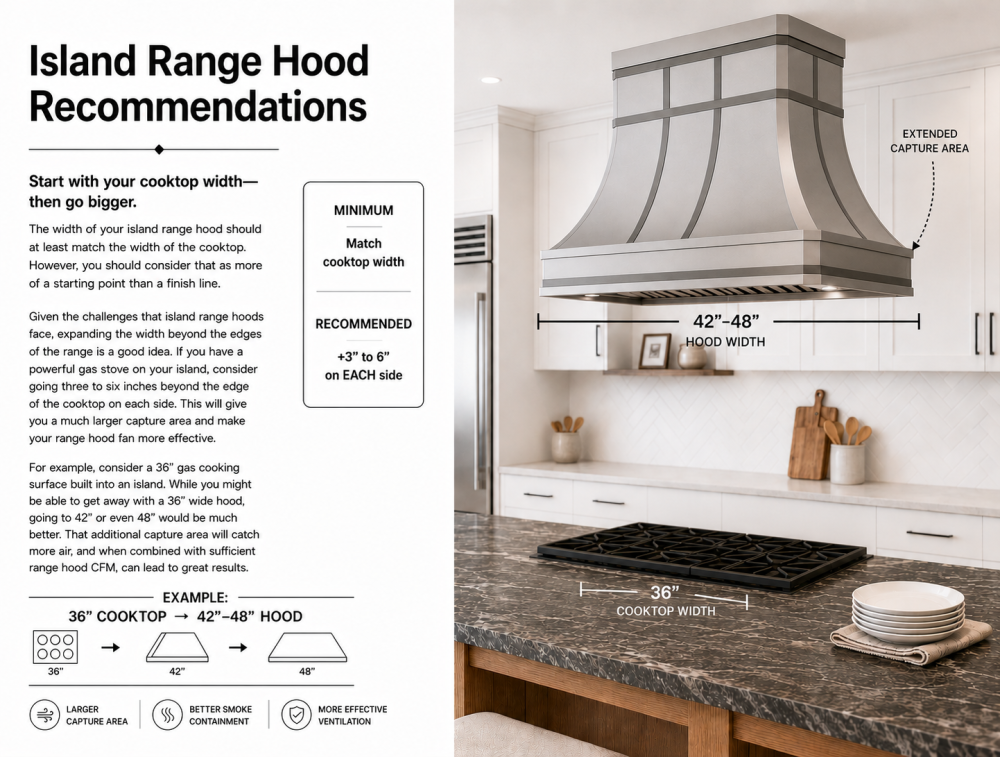
Given the challenges that island range hoods face, expanding the width beyond the edges of the range is a good idea. If you have a powerful gas stove on your island, consider going three to six inches beyond the edge of the cooktop on each side. This will give you a much larger capture area and make your range hood fan more effective.
For example, consider a 36'' gas cooking surface built into an island. While you might be able to get away with a 36'' wide hood, going to 42'' or even 48'' would be much better. That additional capture area will catch more air, and when combined with sufficient range hood CFM, can lead to great results.
Don't Forget About Depth
The two factors that most homeowners focus on are the width of the hood and the cubic feet per minute of air it can move. If they check these two boxes, they expect great ventilation.
However, range hood depth can't be ignored in this equation. Particularly in an island environment, hood depth is critical. After all, a wide hood can still have a modest capture area if it's not deep enough. So, not only should you cover the full stove width (or more) with your hood, but you should also make sure it's deep enough to extend over all of the burners.
Pay particular attention to the front burners. On many gas ranges, the front burners are the most powerful. If your hood doesn't extend far enough over the front of the cooktop, you'll miss catching a big portion of the smoke and steam you create.
Ceiling Height Must Be Considered
A tall ceiling doesn't mean you can mount the range hood higher than you would normally. The hood should still be 30'' to 36'' from the top of the cooking surface, even if you have a 10' or 11' ceiling in the kitchen. Mounting the hood too high will lead to several problems:
-
Air dispersing before reaching the hood
-
Cross-drafts in the room have more time to move the cooking plume
-
Overall capture efficiency decreases and indoor air quality goes down
Fitting an island hood in a kitchen with a tall ceiling usually means using a chimney extension to connect the top of the hood with the ceiling. When done right with beautiful materials, as would be the case with a CopperSmith® range hood, this type of hood can be a show-stopping centerpiece. To make sure the hood's performance matches its look, confirm sufficient CFM airflow and use large ducts to avoid resistance.
Consider a Higher CFM for Island Installations
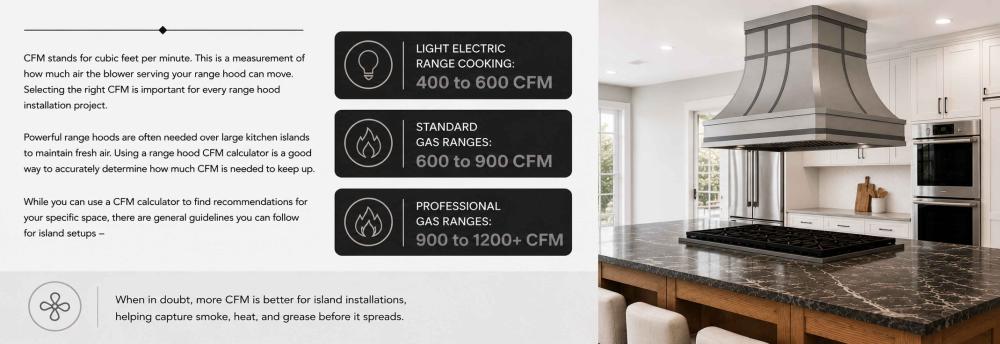
CFM stands for cubic feet per minute. This is a measurement of how much air the blower serving your range hood can move. Selecting the right CFM is important for every range hood installation project.
Powerful range hoods are often needed over large kitchen islands to maintain fresh air. Using a range hood CFM calculator is a good way to accurately determine how much CFM is needed to keep up.
While you can use a CFM calculator to find recommendations for your specific space, there are general guidelines you can follow for island setups -
-
Light electric range cooking: 400 to 600 CFM
-
Standard gas ranges: 600 to 900 CFM
-
Professional gas ranges: 900 to 1200+ CFM
These are starting points, but aren’t the end of the conversation. You should calculate CFM needs while taking into account burner BTU output, cooking style, and more. Working with a contractor to make the final determination may be helpful.
Open-Concept Homes Add Complexity
Many modern homes feature an open-concept design. Such designs are popular for countless reasons, but they can impact how many CFM your range hood needs to move in order to maintain air quality. It often takes the most powerful range hoods to keep up with a high heat output range in an open-concept space.
If you have an open-concept layout around your kitchen, consider increasing both capture area and CFM when planning your hood. You'll also need to have proper makeup air to maintain balance with so much air being pulled up by the ventilation system.
Ensure Sufficient Duct Size to Maintain Airflow
Also, remember to consider duct size in the design of your vent hood. Even with a hood CFM rating of 1200+, you won't get the airflow you need with small ductwork. Most likely, 6'' ducting isn't going to get it done. Look to use at least 8'' ducts, and perhaps upgrade to 10'' if you have a long run or need to use multiple elbows.
Make This Project Easy with CopperSmith®
An island hood is going to play a starring role in your kitchen. Make sure it lives up to the billing by ordering from CopperSmith®. All of our beautiful range hoods can be fully customized to suit your needs and preferences. Each model is expertly crafted and only the best materials are used to ensure durability. Connect with us today to learn more.


 By submitting, you agree to our Privacy Policy & Terms