

Compare copper tabletop finishes by tone, sheen, texture, and expected change, with practical guidance on samples, installation, care, and project cost.

A blue-green copper surface creates contrast with a wood base and pale paving. A finish sample establishes the starting appearance; exposure can change it.
Choose a copper table finish by comparing starting color, sheen, texture, and expected change. Bright copper produces stronger highlights, darker finishes can sit more quietly beside wood or stone, and a patinated surface introduces greater tonal variation. Confirm any coating and care requirements instead of judging the finish from its color name alone.
A copper top gives the table a visible material surface, but color is only one part of the choice. Two tops described as antique copper may differ in sheen, texture, pattern, and protective treatment. The useful comparison is the finish system you will actually live with.
Begin with samples beside the room’s other materials. Then decide whether you want the copper to remain visually steady or to develop a living character. Review the available CopperSmith finishes and designs as starting references, with availability confirmed for the table you select.
Bright Copper: Reflectivity and a Stronger Material Presence
A brighter copper tone brings reddish warmth and noticeable highlights to the room. It can stand apart from cool stone, white cabinetry, or darker furniture. A broad reflective surface may also pick up nearby colors, so judge it in the space rather than against an isolated white background.
Bright, polished, and smooth describe different things. Bright concerns tone; polished concerns surface sheen; smooth concerns texture. Ask for a sample that represents the actual combination you are considering. A bright hammered top and a polished smooth top will not read the same way.
Compare the finish in daylight and after dark. Sit where you expect to eat or work and look toward the light source reflected in the sample. If highlights feel too strong, explore a different sheen, texture, or light position before changing the whole material palette.
Darker Copper: Depth Without a Fixed Style Label
Brown, rubbed, or darker copper tones can relate to timber, stone veining, or dark hardware. They do not belong only in rustic rooms. A simple edge and a restrained base can give the same material a different presence from a heavily detailed table.
Evaluate contrast at the edge as well as across the top. A dark copper surface against a dark base can read as one continuous form; a lighter base can emphasize the separation between top and support. Use a photograph of the room to compare those proportions.
A dark starting color does not automatically mean low maintenance. Fingerprints, dust, spills, and coating marks depend on texture, sheen, and treatment as well as tone. Ask what the finish is designed to do during everyday use.
Patinated Copper: Set Expectations for Variation
A patina can include brown, blue-green, or mixed tones. Some finishes begin with a deliberately developed pattern; other surfaces change gradually through exposure and handling. A selected appearance should be discussed as a range of tones, not a promise that every square inch will match a photograph.
Green is not an automatic sign that a table is suitable outdoors. The Canadian Conservation Institute’s explanation of copper corrosion shows why surface condition and environment matter. For a piece of furniture, the substrate, edge, base, and approved finish must also suit its location.
Ask whether the patina is left exposed or protected, how the treatment affects sheen, and whether localized refinishing is possible. For outdoor placement, review tables specified for exterior use rather than assuming a weathered color establishes weather resistance.
Can You Add a Copper Top to an Existing Table?
A new top can be an option, but the existing table needs to be assessed as a complete structure. Check whether its base will support the proposed size and weight, how the top will be fixed, and whether the finished height leaves enough clearance for the intended chairs.
Edge construction deserves particular attention. Exposed sheet edges, corners, joins, and transitions must be designed and finished properly. A thin sheet attached with a convenient adhesive is not a substitute for resolving the substrate, bonding system, and edge detail.
Discuss the project with a furniture maker or fabricator and compare the available tabletop options. For base coordination, use the guide to choosing a copper table base to frame the dimensions and support questions.
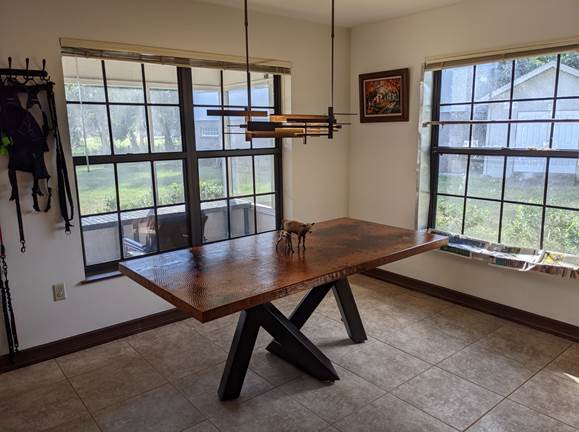
Copper connects the table surface with the warmer tones in the room. Base position and chair clearance deserve the same attention as the finish.
Care: Protect the Finish You Chose
Identify the finish before choosing a cleaner. Keep abrasive pads and unapproved polishing compounds away from the surface. A method intended to brighten bare copper can erase the darker tones that made a patinated top appealing in the first place.
Request a written routine for spills, dust, water rings, and any protective treatment. Do not assume every top should be waxed on the same schedule, or that a particular furniture wax is compatible with every coating. Follow the approved instructions and retain them with the order record.
Use coasters, placemats, and trivets as part of the setup. A surface can be durable furniture without being a cutting board, hot-pan rest, or direct food-preparation area. The daily routine should preserve the chosen appearance without demanding care you will not realistically follow.
Cost: Compare the Complete Specification
Copper table cost depends on more than the color of the finish. Dimensions, edge construction, base, fabrication, finish treatment, delivery access, and installation can all affect the project. Compare quotations that describe the same requirements.
Ask which sample or finish reference will be attached to the order and what variation is expected. Clarify whether delivery, assembly, and any site-specific work are included. Avoid assuming that a more expensive-looking patina automatically represents a higher or lower total cost.
A Practical Sample Review
Place the copper sample beside the actual cabinet, flooring, and fabric samples. Photograph the arrangement in daylight and under the evening lighting, but make the final judgment in person. Record the finish name, texture, sheen, coating, and care instructions together.
The Trestle TR1 metal dining table is one example to review when comparing the relationship between top and base. Confirm which finish combinations and dimensions are available for the configuration you want.
Common questions
Is darker copper easier to maintain than bright copper?
Not automatically. Maintenance depends on the finish and any protective treatment, as well as use. Compare care requirements alongside the samples.
Will the delivered finish exactly match the sample?
A sample establishes the intended material character. Ask the maker to describe acceptable variation, especially for patinated and textured surfaces.
Does a blue-green copper top belong only outdoors?
No. Color alone does not determine placement. Select the appearance for the room, then confirm that the complete construction is approved for the intended environment.
Updated October 29, 2026. Originally published 2015-01-04. Care and suitability depend on the selected product and finish.
Define the details around your space.
Review starting tone, texture, sheen, and expected aging together. Bring the surrounding material samples so the table can be defined as part of the room.
Compare copper table designs

 By submitting, you agree to our Privacy Policy & Terms