

How high above the cooktop should your range hood be placed? This seemingly simple question can get a little complicated when you consider the variables involved. Nail down this critical placement early in your project to avoid headaches later on.
Start with These Standard Range Hood Height Options
As a general starting point, most range hoods can be mounted at the following heights above the cooking surface -
-
Electric cooktop - 24'' to 30'' above the cooking surface
-
Gas cooktop - 30'' to 36'' above the cooking surface
Why is there a difference between gas and electric? With gas, you have an open flame on the cooktop and higher heat output. That intensity means you will want more clearance for better airflow and safety. You don't need as much clearance with electric because there’s no open flame and the heat source isn't as powerful.
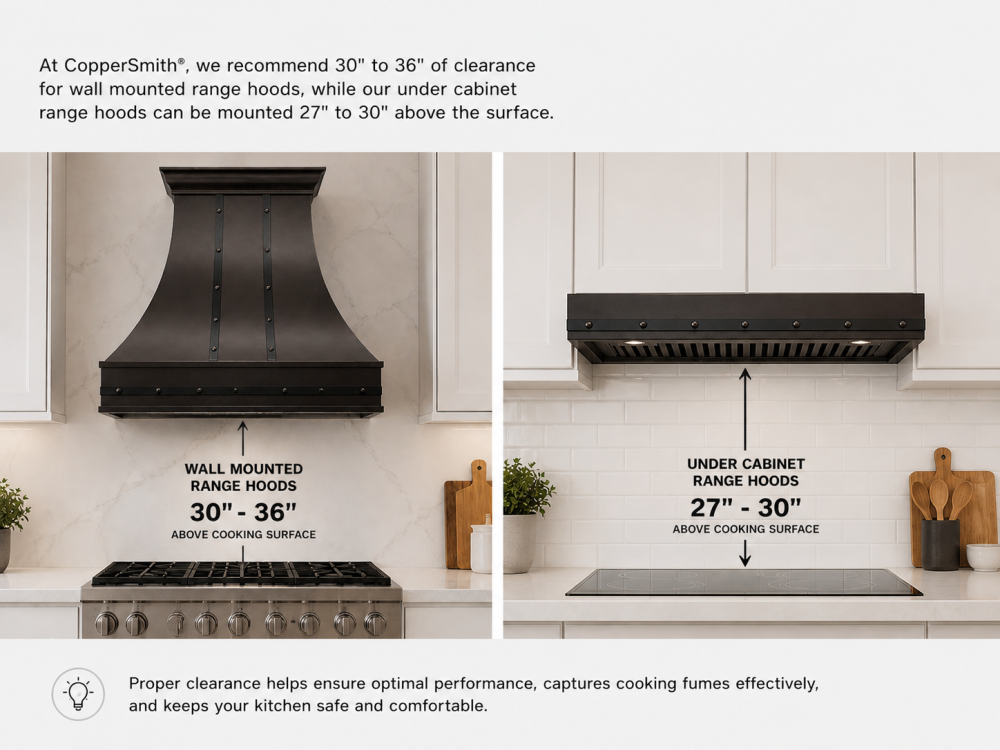
Also consider the type of hood you’re installing. At CopperSmith®, we recommend 30'' to 36'' of clearance for wall mounted range hoods, while our under cabinet range hoods can be mounted 27'' to 30'' above the surface.
The Connection Between Height and Performance
Choosing the best range hood height is a matter of balance. You want the hood close enough to your gas cooktop or electric range to capture smoke, heat, and steam, but not so close that it gets in the way of the cooking process.
If the hood is too close to the cooktop, you won't have headroom in front of the range, and you might struggle to see anything but the front burners. Also, the hood will be directly exposed to the heat source (especially with gas), potentially damaging the hood's materials over time.
Mounting your hood higher will alleviate these practical concerns. However, if you go too high, optimal venting will be lost. The plume of smoke and steam coming off the stove will expand outward before it’s captured by the hood. You may also have problems with grease landing on nearby cabinet surfaces, and even the ceiling of the kitchen.
The mounting height guidelines above are important because they represent the "Goldilocks" zone for performance and function. Your vent hood will work nicely at those heights without getting in the way of cooking your meals comfortably.
Consider Cooktop Size and Hood Width
Don't get so caught up in the height of your hood above the cooktop that you forget about hood size. Specifically, the hood needs to be wide enough to effectively capture the plumes that rise from the surface.
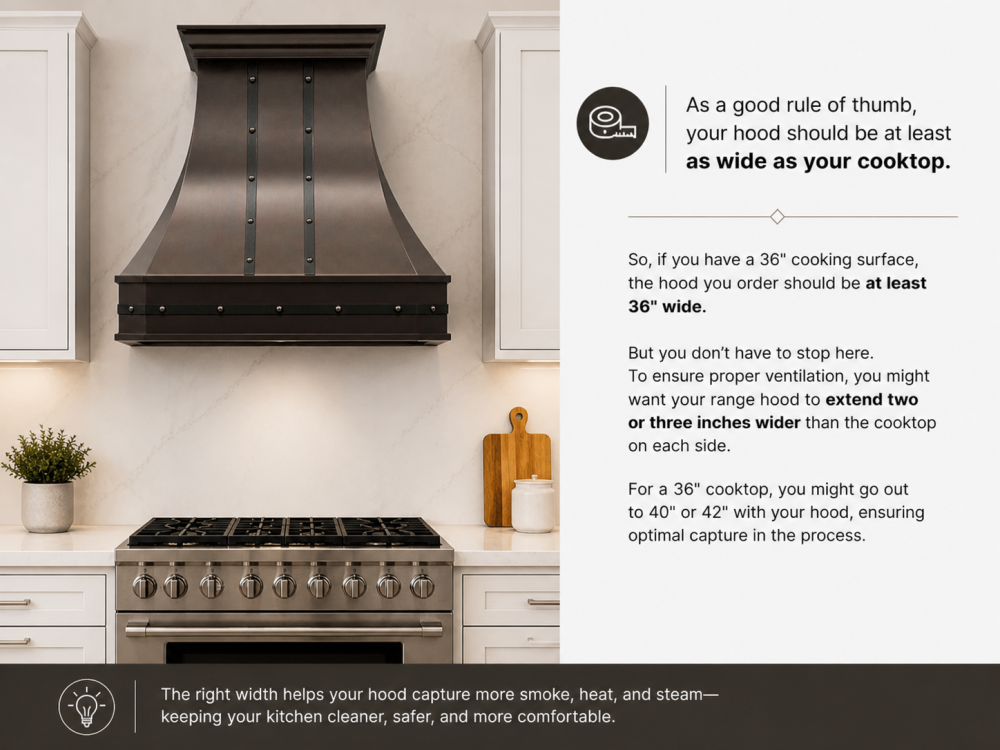
As a good rule of thumb, your hood should be at least as wide as your cooktop. So, if you have a 36'' cooking surface, the hood you order should be at least 36'' wide. But you don't have to stop here. To ensure proper ventilation, you might want your range hood to extend two or three inches wider than the cooktop on each side. For a 36'' cooktop, you might go out to 40'' or 42'' with your hood, ensuring optimal capture in the process.
Getting Creative with High Ceilings
Many luxury kitchens have high ceilings. Tall ceiling height opens up many great design possibilities, but it can complicate the range hood placement a bit.
You might be tempted to install a wall mount hood higher than the 30'' to 36'' recommended above just to take up vertical space. That would be a mistake. It might look good on the wall, but a hood mounted more than three feet above the range won't perform well.
This is where working with an experienced partner like CopperSmith® is so important. You can customize your order with us to create a range hood that rises dramatically to the ceiling while still being at the proper height to catch cooking fumes. A model like the Euro ES3 is great for this situation, but nearly all of our hoods can be adapted to work nicely with tall ceilings.
Island Installations Also Require Careful Thought
Island range hoods face the additional challenge of not having a wall to help contain airflow. With open space all around, it's harder to capture the cooking plume and direct it out of the house. This issue is only made worse in open floor plan spaces where air currents and drafts from HVAC systems threaten to move steam and smoke around before it reaches the hood.
There are a couple of ways to combat this challenge. The first is to upgrade to a blower with a higher CFM, or cubic feet per minute, rating. A more powerful motor will help the hood pull air up from the cooktop before it can get away.
The other adjustment is to move the hood slightly closer to the cooktop. You still need to stay within the safe range, so likely at least 30'', but favoring lower rather than higher will provide a performance boost. Also, consider ordering a hood that is larger than your cooktop to enhance the capture area.
Three Common Misconceptions
Let's take a moment to look at a few common misconceptions about range hood placement and what it means for performance.
#1 - Higher Means Better Ventilation
Some people believe that mounting a hood higher will allow it to catch more air as it runs. That's not how it plays out in the real world, however.
In reality, as smoke rises from your cooktop, it expands outward. Mounting the hood higher only gives the smoke more time to spread out, meaning less of it will be captured by your ventilation system. To optimize capture efficiency, keep the hood height within the recommended range of 30'' to 36'' for most projects.
#2 - More CFM Fixes Poor Placement
You can't solve your range hood placement problems just by upping the power on your blower. Sure, a more powerful blower can be helpful in some situations, as with island range hoods.
But CFM and placement have to work together. Even a powerful blower isn't going to capture the part of the plume that’s already spread out before it gets to the hood.
#3 - All Kitchens Are the Same
There’s no one single installation plan that’s going to work for every kitchen. Too many variables exist for that to be the case.
Factors that come into play include the size and power of the cooktop, whether it's electric or gas, where it's located in the kitchen, and what kind of cooking will be done. Almost any range hood will properly vent a small electric cooktop, while a professional-style gas range needs strategic ventilation planning for good results.
Design Your Ideal Hood Today
Think you’re stuck choosing a prefabricated range hood for your new kitchen? Not with CopperSmith®. When you team up with us, you'll have access to custom range hoods crafted by experts using only the best materials. Explore our site to see the endless options, including copper range hoods, stainless, brass, and more. Contact us directly if you have any questions.


 By submitting, you agree to our Privacy Policy & Terms