PROPORTION,
RESOLVED
Dimensions and profile are considered in relationship to your cabinetry, cooking surface, and surrounding architecture, so the hood feels intentional within the space.
Need Help? Talk With a Specialist
Dimensions and profile are considered in relationship to your cabinetry, cooking surface, and surrounding architecture, so the hood feels intentional within the space.
Ventilation is engineered alongside the design, bringing performance requirements and architectural intent together from the start.
Real metal, finish, and architectural details are selected for what they bring to the larger design, from tone and contrast to texture, variation, and character.
Detailed CAD drawings bring every decision together before fabrication. Once approved, those specifications guide production through the finished piece.
ARCHITECTURAL METALWORK FOR THE DESIGNED HOME.
 Based on thousands of third-party reviews.
Explore the possibilities and make your initial selections. Our team is available to guide dimensions, material, finish, performance, and architectural details.
We translate your selections into a detailed CAD drawing so you can review dimensions and key specifications before fabrication.
With the drawing approved, your piece moves into fabrication and finishing, guided by the specifications you've reviewed.
Your finished piece is inspected, carefully packaged, and coordinated for delivery to your project.
Have a question about your design, dimensions, finish, or next step? Our team can help you resolve the details and move your project forward with confidence.
REMOTE AIRFLOW, ISLAND-HOOD INTEGRATION, VARIABLE-SPEED CONTROL.
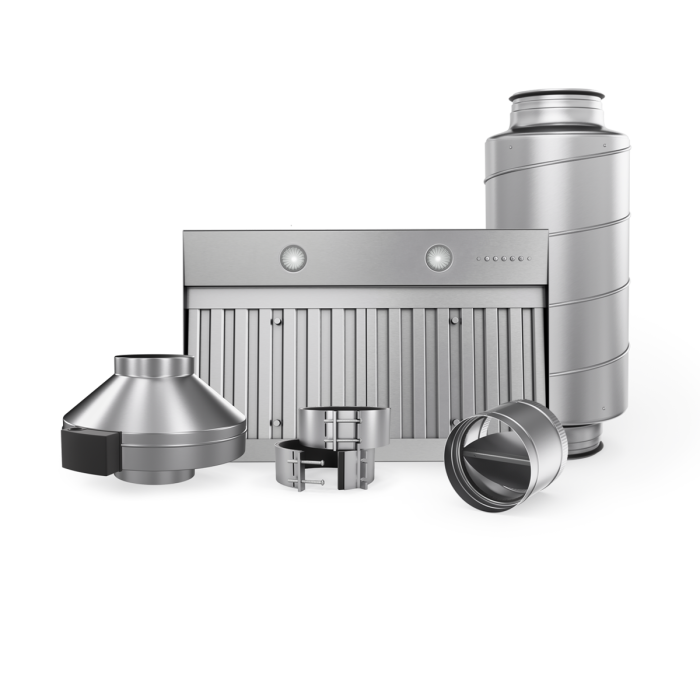
The Island Mount Remote Blower moves the motor away from the suspended hood while maintaining extraction at the island cooking surface. Its project-specific coordination helps protect the visual clarity of the hood while resolving the duct and airflow plan.
Provide remotely located extraction for a compatible island range hood. The component should be treated as part of one air path, coordinated with the hood or appliance, liner, duct dimensions, termination, and installation conditions.
Coordinate remote motor placement, duct route, and island-liner connection. Compatibility and final fit should be confirmed against the selected equipment and current project documents.
The system preserves the architectural presence of the hood while providing the required kitchen ventilation.
Durable metal construction with a corrosion-resistant finish. Follow the blower and liner documentation for access, cleaning, and service. Accessible placement and correct installation help the system perform as specified over time.
The Island Mount Remote Blower must be coordinated with the hood, liner, duct route, airflow plan, and field conditions. Current product and installation documents provide the definitive project specification.
Ventilation performance depends on the complete system, including capture area, liner or insert, blower, duct diameter and route, make-up air, termination, filters, and installation. Confirm all components before ordering.
The Island Mount Remote Blower moves the motor away from the suspended hood while maintaining extraction at the island cooking surface. Its project-specific coordination helps protect the visual clarity of the hood while resolving the duct and airflow plan.
Provide remotely located extraction for a compatible island range hood. Its role must be considered within the complete ventilation system rather than as an isolated component.
Coordinate remote motor placement, duct route, and island-liner connection.
Durable metal construction with a corrosion-resistant finish.
Airflow and duct dimensions are selected for the project. Confirm the selected option against the project requirements before ordering.
CopperSmith® and comparable island hoods with an approved liner and duct system. Compatibility must be verified for the specific hood, liner, duct route, and installation.
Variable fan-speed control through the coordinated hood system.
Remote motor used with the compatible liner, ductwork, and required connection components. Review the current product documents for the exact ordered configuration.
Confirm dimensions, clearances, duct connections, airflow requirements, service access, electrical needs where applicable, and all current installation instructions.
Follow the blower and liner documentation for access, cleaning, and service. Follow the current care and service documentation for the complete system.
No single component determines performance. Capture area, liner or insert, blower, duct diameter and route, termination, filters, make-up air, and installation all affect the result.
Match the product code and selected option to the hood and ventilation plan, then have the installer verify field conditions and applicable code requirements before ordering.

 By submitting, you agree to our Privacy Policy & Terms